Why SIBO Comes Back: Relapses and How to Prevent Them
SIBO recurs often after treatment because the antibiotic clears the bacteria but does not fix the underlying cause. Here are the real relapse rates from a published study and the verified risk factors, along with what can be done about them.
Editorial standards for this guide
Editorial lead
Beiker Guillen
Published
Last updated
Last editorial review
This content is for educational purposes. It summarizes public evidence, explains it in plain English, and avoids closed recommendations when the literature is uncertain or depends on clinical context.
You can review how we select sources, how we update older pieces, and the editorial limits we follow in our editorial methodology .
💡 Why does SIBO come back after treatment?
Because the antibiotic clears the bacteria from the small intestine but does not repair the cause that allowed them to build up in the first place. If that underlying cause is still there (slow motility of the migrating motor complex, ongoing use of proton pump inhibitors, an anatomical abnormality, or an untreated condition), the terrain still favors regrowth. In a study of 80 adults treated with rifaximin, breath-test recurrence was 12.6 percent at 3 months, 27.5 percent at 6 months, and 43.7 percent at 9 months (Lauritano 2008). The good news is that the strongest risk factors are identifiable and, in part, modifiable.
Why SIBO Comes Back: Relapses and How to Prevent Them
You finished treatment, your symptoms eased, and a few weeks or months later the bloating and gas came right back as if nothing had happened. If that sounds familiar, you’re not doing anything wrong: SIBO recurrence is one of the defining features of the condition, not an exception. This guide answers why it happens, how often it occurs according to a real study, which factors make it more likely, and what can be done to tip the odds in your favor.
Author’s note: I’m not a doctor. I built sibowise.com while supporting my sister after her SIBO diagnosis. The relapse was, by far, the most demoralizing part of the process: investing weeks in treatment and diet, feeling relief, and then watching it all come back. What helped me most to keep from experiencing it as a personal failure was understanding that recurrence has concrete, well-documented mechanisms. This guide brings those mechanisms together with figures from real studies, so you walk into your appointment knowing what to ask.
Recurrence is common: what the numbers show
The figure cited most often—and rarely explained well—comes from an Italian study by Lauritano and colleagues (2008), published in the American Journal of Gastroenterology. They followed 80 adults who had been successfully treated for SIBO using rifaximin 1,200 mg per day for one week and repeated the glucose breath test over time.
The result, expressed as the percentage of the 80 patients who tested positive again on the breath test:
| Time since treatment | Percentage with recurrence |
|---|---|
| 3 months | 12.6 percent |
| 6 months | 27.5 percent |
| 9 months | 43.7 percent |
The honest reading of this table: this is not “the” relapse rate for all SIBO. It’s what happened in this specific cohort, measured by breath test, after one particular rifaximin regimen. But the trend it shows is clear and matches what other work reports: the more time passes, the higher the proportion of relapses climbs. For nearly half the group, SIBO had returned before the one-year mark.
That’s why it’s worth shifting your expectations. The realistic goal isn’t always to “kill the bacteria once and forget about it,” but rather to treat the overgrowth and, in parallel, work on the cause that allowed it. If the second part isn’t done, the figures above explain why the problem comes back.
The underlying reason: the antibiotic doesn’t repair the terrain
The small intestine, unlike the colon, is designed to hold few bacteria. It’s kept that way by a combination of defenses: stomach acid, bile, enzymes, the ileocecal valve, and, above all, a cleaning mechanism called the migrating motor complex (MMC), a “housekeeper wave” of contractions that sweeps through between meals, carrying debris and microbes toward the colon.
SIBO doesn’t appear because unusual bacteria “arrive”: it appears because one of those defenses failed and let the normal bacteria build up where they shouldn’t. The antibiotic reduces the bacterial population, but it doesn’t fix the defense that failed. If that piece is still broken, the terrain again favors overgrowth. This is exactly what connects treatment with the root causes of SIBO: treating without addressing the cause is like draining a sink with the faucet still running.
Relapse risk factor table
These are the factors the literature associates with a higher likelihood of SIBO returning. I separated what has a verified number from what is a predisposition described qualitatively by clinical guidelines, so you don’t confuse how solid each row is.
| Risk factor | Why it favors relapse | How well supported it is | Room to act |
|---|---|---|---|
| MMC / slow motility | If the housekeeper wave doesn’t pass regularly, bacteria stay put and multiply in the small intestine. The ACG calls the MMC “a natural protection against SIBO” (Pimentel 2020) | Central mechanism, recognized in the ACG clinical guideline | Partial: it can be supported with habits and, in some cases, with prescription prokinetics |
| Chronic PPI use (omeprazole and similar) | They reduce stomach acid, one of the barriers that limits bacterial entry and growth | In Lauritano 2008, chronic use of proton pump inhibitors was associated with recurrence (OR 3.52; 95 percent CI 1.07–11.64). A 2025 meta-analysis of 29 studies found a higher risk of SIBO in PPI users overall (OR 2.14; 95 percent CI 1.45–3.18) | Potentially high, but only with your doctor: a PPI is never stopped on your own |
| Anatomical abnormalities (blind loop, diverticula, strictures, adhesions, prior surgery, history of appendectomy) | They create “backwaters” where contents stagnate and bacteria accumulate, beyond the reach of the housekeeper wave | A history of appendectomy was associated with recurrence in Lauritano 2008 (OR 5.9; 95 percent CI 1.45–24.19); the ACG describes structural abnormalities as a predisposing factor | Limited: many are not modifiable; they’re managed with medical follow-up |
| Untreated root cause | If the condition that triggered the SIBO is still active (prior gastroenteritis, hypothyroidism, diabetes, scleroderma, adhesions), the terrain keeps favoring overgrowth | A cross-cutting clinical concept; management depends on the specific cause | Variable: depends on which condition it is and how treatable it turns out to be |
One important clarification about the two PPI figures, because they measure different things: the OR 3.52 from Lauritano is about recurrence after treatment in a cohort of 80 people; the OR 2.14 from the 2025 meta-analysis is about the risk of developing SIBO among PPI users in general, not about relapse. That same meta-analysis also found a duration-dependent relationship: the more months of PPI treatment, the higher the prevalence of SIBO. They’re not interchangeable, but they point in the same direction.
Age and other contributing factors
In the same Lauritano 2008 analysis, older age was also independently associated with recurrence (OR 1.09; 95 percent CI 1.02–1.16 per year). It’s not a factor you can act on, but it helps explain why two people with the same treatment can have different trajectories. What’s actionable isn’t age itself, but the factors that tend to accompany it: more use of medications that slow the gut, more prior abdominal surgeries, a higher likelihood of reduced motility.
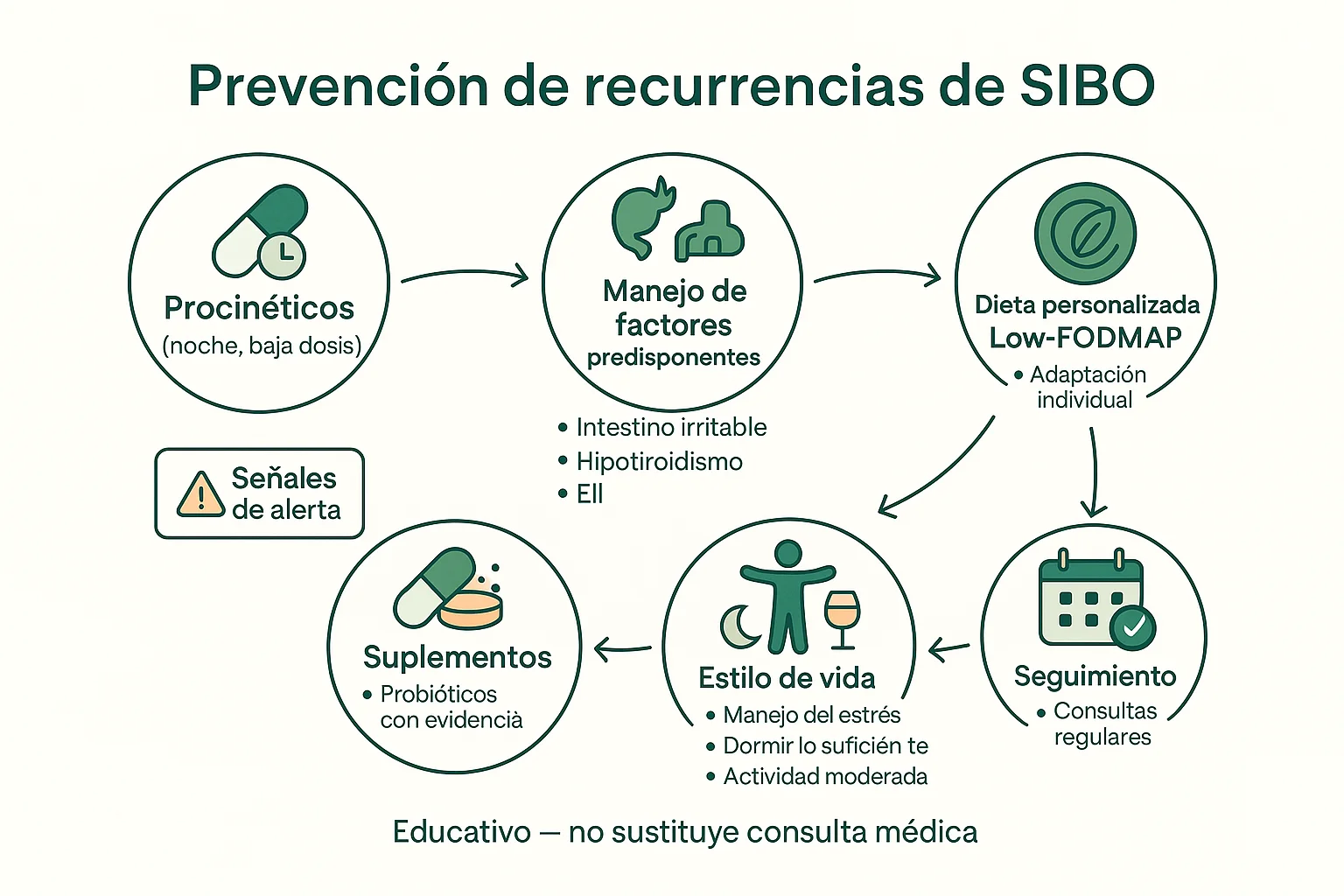
What can be done to lower the risk of relapse
None of these measures is a guarantee, and they’re all decided with your medical team. But they are the levers the literature describes for keeping SIBO at bay after treatment.
1. Support small intestine motility. This is the most studied lever. The idea is to get the MMC’s housekeeper wave passing regularly again so the bacteria don’t linger. This includes habits (spacing out meals, not eating continuously so the cleaning phase can occur) and, in some cases, prescription prokinetics. Since this has its own depth—which drugs, which doses, what evidence—we cover it separately in the guide on prokinetics and the migrating motor complex. If you want to understand the mechanism of the housekeeper wave first, it’s explained in what the migrating motor complex is.
2. Review PPIs with your doctor. If you take a proton pump inhibitor chronically, it’s a conversation worth having: is it still needed at this dose? Are there alternatives? Can the indication be reassessed? The decision is a medical one and should never be made on your own, because stopping a PPI without guidance can cause other problems. But the data above justify raising the question.
3. Treat the root cause. This is what separates someone who relapses again and again from someone who achieves long stretches without symptoms. If the SIBO came from uncontrolled hypothyroidism, from adhesions, from a motility condition, or from any other underlying cause, that’s the front that changes the long-term picture. To map possible causes in your case, review the root causes of SIBO.
4. Space out your meals. Since the MMC only works on an empty stomach and is interrupted the moment you eat, grazing all day means the housekeeper wave almost never completes its cycle. Leaving windows of several hours between meals, without skipping the nutrition you need, gives the gut room to clean itself. It’s a simple, cost-free, low-risk measure.
5. Confirm the result, don’t just assume it. Knowing whether SIBO actually came back—and that it isn’t something else—requires reassessment. The breath test is the most commonly used tool to document recurrence, just as it was used in the Lauritano study. Reacting to the first symptom with another round of antibiotics without confirming can lead to unnecessary treatments.
How to reframe a relapse
It’s worth closing with a shift in framing. A relapse doesn’t mean the treatment “didn’t work” or that you did something wrong. The Lauritano figures show that recurrence is the statistical norm when only the overgrowth is treated without touching the cause. The useful question isn’t “why did it come back to me?” but “which underlying factor is still open, and what can be done about it?” That question—with your doctor, with the data in hand—is what changes the trajectory.
A necessary note
This guide is educational material, a summary of public sources, not medical advice. The figures come from specific studies in specific populations and do not predict your individual case. Decisions about medications—including PPIs and prokinetics—and about repeating treatment should be made with a health professional who knows your history.
References
- Lauritano EC, Gabrielli M, Scarpellini E, et al. Small Intestinal Bacterial Overgrowth Recurrence After Antibiotic Therapy. Am J Gastroenterol. 2008;103(8):2031-2035. PMID 18802998. Abstract on ACG/AJG
- Pimentel M, Saad RJ, Long MD, Rao SSC. ACG Clinical Guideline: Small Intestinal Bacterial Overgrowth. Am J Gastroenterol. 2020;115(2):165-178. Guideline PDF (AGA/ACG)
- Khurmatullina AR, et al. The Duration of Proton Pump Inhibitor Therapy and the Risk of Small Intestinal Bacterial Overgrowth: A Systematic Review and Meta-Analysis. Journal of Clinical Medicine. 2025. Full text on PMC
Important editorial note
This information is for educational purposes only and does not replace individualized professional advice. Always discuss decisions about your health with a qualified professional.
Sources and references
These references guide how this piece is written and updated. They do not replace individual clinical assessment.
Reference1
ACG Clinical Guideline: Small Intestinal Bacterial Overgrowth (2020)Guía clínica del American College of Gastroenterology para diagnóstico y tratamiento.
Reference2
AGA Clinical Practice Update on Small Intestinal Bacterial Overgrowth (2020)Actualización de buenas prácticas con énfasis en límites diagnósticos y manejo clínico.
Reference3
The migrating motor complex: control mechanisms and role in health and disease (2012)Revisión sobre fisiología del complejo motor migratorio y motilidad digestiva.
Beiker Guillen
Founder of Sibo Wise
I'm not a health professional — I'm a software developer. I started Sibo Wise when my sister was diagnosed with SIBO and I saw how hard it was to find clear, trustworthy information. My role here is research and organization: I gather what serious medical sources say —clinical guidelines from the ACG and AGA, Monash University materials, and PubMed-indexed studies— and cross-check every claim against its original source before publishing.
This content does not replace professional medical advice. If you have any concerns about your health, consult a qualified gastroenterologist or dietitian.