Root Causes of SIBO: Why Treating Them Prevents Relapse
The causes of SIBO are not a random list: motility, anatomy, stomach acid, and underlying diseases are the mechanisms that explain why overgrowth comes back if you only kill the bacteria.
Editorial standards for this guide
Editorial lead
Beiker Guillen
Published
Last updated
Last editorial review
This content is for educational purposes. It summarizes public evidence, explains it in plain English, and avoids closed recommendations when the literature is uncertain or depends on clinical context.
You can review how we select sources, how we update older pieces, and the editorial limits we follow in our editorial methodology .

💡 What are the root causes of SIBO?
SIBO appears when the defenses that keep the small intestine relatively empty break down. The literature groups the causes into three mechanisms: altered motility (especially the migrating motor complex that sweeps bacteria away between meals), anatomical alterations that create stagnant zones (adhesions, diverticula, surgical blind loops, resection of the ileocecal valve), and the loss of chemical barriers such as stomach acid. Diseases like scleroderma, diabetes with neuropathy, and hypothyroidism act through these same mechanisms. Treating only the overgrowth without correcting the underlying cause is the main reason SIBO relapses: up to 43.7% of patients have a positive test again 9 months after a course of antibiotics.
SIBO is almost never an isolated accident. It is the result of one or more of the defenses that keep the small intestine relatively clean failing to work. That is why “the cause” is rarely a single thing, and why overgrowth tends to come back when you only reduce the bacterial load with antibiotics or antimicrobials but do not correct the mechanism that allowed it.
This guide is not a loose list of factors. It is a map of how each cause breaks a specific defense and why that predicts relapse. If you understand the mechanism, you understand why two people with the same bloating need different strategies.
Author’s note: I’m Beiker, a developer, not a doctor. I started reading about SIBO when my sister was diagnosed, and what I struggled most to understand —and what almost no one explained clearly— was this: why, after a treatment that “worked,” the symptoms came back months later. Most pages listed causes as if they were a menu, without connecting any of them to recurrence. This guide summarizes what I learned by organizing public medical sources: overgrowth isn’t “cured” by killing bacteria if the terrain that let them grow is still intact.
The Three Defenses of the Small Intestine
Under normal conditions, the small intestine has far fewer bacteria than the colon. It is kept that way by a system of defenses that the landmark review on SIBO (Bures et al., World J Gastroenterol 2010) sums up in just a few elements: the secretion of stomach acid, intestinal motility, a competent ileocecal valve, the immunoglobulin A in secretions, and the bacteriostatic properties of bile and pancreatic juice.
The same review classifies the causes of SIBO according to which defense fails, and that is the most useful framework for not getting lost:
| Category | Mechanism that breaks | Concrete examples | Why it favors relapse |
|---|---|---|---|
| Altered motility | The migrating motor complex stops “sweeping” the bacteria away between meals; contents stagnate | Scleroderma, diabetic autonomic neuropathy, hypothyroidism, pseudo-obstruction, post-infectious sequelae | If the sweep isn’t restored, the bacteria build up again even after being reduced with antibiotics |
| Anatomical alterations | Stagnant zones form where flow doesn’t reach | Post-surgical adhesions, diverticula, fistulas, surgical blind loop, resection of the ileocecal valve | The physical “reservoir” persists; it’s a structural problem, not a microbiological one |
| Loss of chemical barriers | The filter that kills or slows bacteria before the small intestine drops away | Achlorhydria (atrophic gastritis), prolonged use of proton pump inhibitors, pancreatic insufficiency, IgA deficiency | As long as the barrier stays low, bacteria keep surviving and migrating |
The three categories can coexist. A person who has had abdominal surgery, has hypothyroidism, and takes an acid suppressant daily has three mechanisms open at once.
1. Motility: The Sweep That Fails (the cause most tied to relapse)
Between meals and during fasting, the intestine runs the migrating motor complex (MMC), a sequence of contractions that acts as an interdigestive “housekeeper.” Its phase III —the phase of intense contractions— appears every 90 to 120 minutes during fasting and is interrupted as soon as food enters (Deloose et al., review on the MMC). That phase III pushes debris and bacteria toward the colon.
The connection to SIBO is direct: the same review notes that bacterial overgrowth may be due to a motility disorder with near-complete absence of the interdigestive MMC. If the sweep doesn’t happen, the bacteria don’t leave: they stay and proliferate.
Here is the key to relapses. An antibiotic lowers the bacterial load, but it doesn’t repair the sweep. If the MMC still isn’t working, the terrain favors overgrowth again. That’s why, in people with slow motility, follow-up usually looks at motility —not just repeating the test. We go deeper into this system in the guide on the migrating motor complex and in the strategies discussed in prokinetics, motility, and the MMC. And if your concern is SIBO coming back, we gather the recurrence factors in why SIBO comes back.
The Post-Infectious Case: When Gastroenteritis Damages the Sweep
It’s one of the best-described mechanisms and connects two ideas that seemed unrelated. After food poisoning by germs such as Campylobacter jejuni, the body generates antibodies against a bacterial toxin called CdtB (cytolethal distending toxin B). The problem is molecular mimicry: CdtB resembles vinculin, a protein native to the intestine. The immune system ends up attacking vinculin as well.
In a rat model (Pimentel et al., Dig Dis Sci 2015), the anti-CdtB antibodies bound to vinculin in the interstitial cells of Cajal —the electrical “pacemaker” that coordinates motility— and the antibody level and the loss of vinculin correlated with the number of infections and with the appearance of SIBO. The mechanistic chain is: infection → autoimmunity against vinculin → damage to the cells of Cajal → weakened MMC phase III → bacteria stop being swept away → overgrowth. As another review on these antibodies summarizes: “the absence or reduction of phase III contractions results in small intestinal bacterial overgrowth in animal models and in patients with IBS.”
There is a blood test (ibs-smart, available mostly in the U.S.) that measures anti-CdtB and anti-vinculin; in studies, both are more elevated in IBS than in controls. It still does not have a validated clinical cutoff for individual use, so it adds context, not a diagnosis on its own.
2. Anatomy: Stagnant Zones That Can’t Be “Killed”
When the structure of the intestine creates a space where flow doesn’t reach, that corner becomes a bacterial reservoir. It’s a physical problem, not a microbiological one, and that’s why it’s among those that most predispose to recurrence: the antibiotic empties the reservoir temporarily, but the reservoir is still there.
The Bures review lists the typical anatomical alterations: small intestinal obstruction, diverticula, fistulas, surgical blind loop, and prior resection of the ileocecal valve. That valve deserves attention of its own: an intact ileocecal valve prevents the retrograde translocation of bacteria from the colon to the small intestine. If it is resected or doesn’t close well, the colon —which has an enormous bacterial load— can “seed” upward.
Adhesions from abdominal or pelvic surgery and conditions such as endometriosis fall here when they alter transit. One piece of data connecting anatomy with relapse: in Lauritano’s follow-up study (below), a history of appendectomy was one of the predictors of recurrence (OR 5.9). It doesn’t mean that every prior surgery explains current symptoms; it does mean that the surgical timeline is relevant information for the consultation.
3. Stomach Acid: The Chemical Barrier That Filters What Comes Down
Stomach acid kills a good part of the bacteria before they reach the small intestine. When that acid drops —because of atrophic gastritis (achlorhydria) or prolonged use of proton pump inhibitors (PPIs)— bacteria that normally wouldn’t survive and migrate. Bures says it directly: achlorhydria and prolonged PPI use “can cause bacterial overgrowth in the stomach and duodenum.”
Here the numbers help to size up the effect, without overstating it:
- Meta-analyses find a moderate association between PPIs and SIBO, not a direct cause.
- A recent meta-analysis (2025) described a duration-dependent association: OR 2.14 (95% CI 1.45–3.18), with an increase in risk for each additional month of treatment. The prevalence of SIBO was 36.8% in PPI users versus 19.9% in controls.
The important nuance: this is not a reason to stop a PPI on your own. It was often prescribed for something serious (ulcer, Barrett’s esophagus, bleeding), and withdrawing it without supervision can be riskier than keeping it. The useful conversation is to review whether the indication still applies, not to drop it automatically.
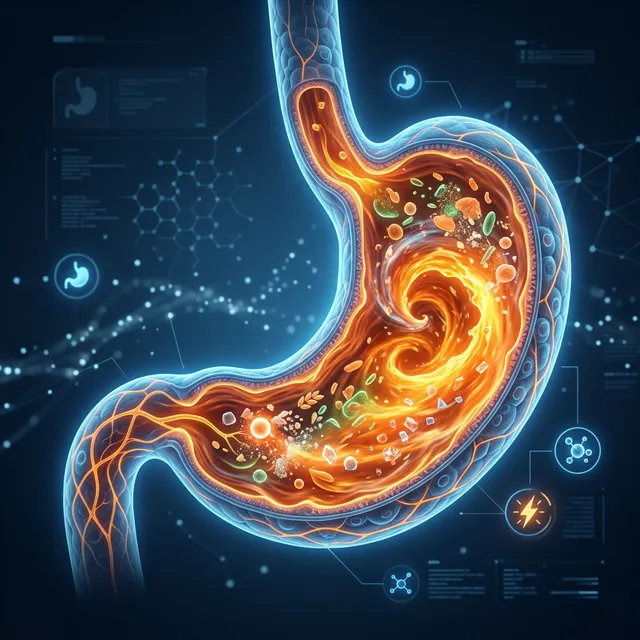
Stomach acid is one of the barriers that keep the small intestine’s bacterial load low; reducing it too much shifts that balance. It should not be assumed or “treated” on your own.
4. Underlying Diseases: They Act Through Motility
Several conditions are not “another category” of cause: they are ways of breaking motility. Checking for them matters because, if they’re active and untreated, SIBO relapses even when it’s treated well.
- Scleroderma (systemic sclerosis): the fibrosis of the intestinal wall and the neural damage alter motility and clearance; it’s one of the most recognized causes of dysmotility in SIBO.
- Diabetes with autonomic neuropathy: the nerve damage slows gastric emptying and the sweep. The prevalence of SIBO in diabetes runs around 29% in meta-analyses, and it rises in those who have gastroparesis: up to ~41% of patients with gastroparesis have SIBO.
- Hypothyroidism: low thyroid function reduces gastrointestinal activity and slows transit.
- Celiac disease and inflammatory bowel disease: they alter motility, absorption, and inflammation, and they overlap in symptoms, so it’s worth ruling them out.

The vagus nerve takes part in the regulation of motility. Sustained stress can influence transit and the perception of symptoms, but it doesn’t replace a clinical evaluation of the structural and metabolic causes.
Why All of This Matters: The Relapse Evidence
The argument of “treat the cause, not just the bacteria” is not theoretical. The follow-up study by Lauritano et al. (2008) treated 80 patients with SIBO with rifaximin 1,200 mg/day for one week and re-measured with a breath test. The overgrowth reappeared in:
- 12.6% at 3 months,
- 27.5% at 6 months,
- 43.7% at 9 months.
And digestive symptoms rose along with test positivity. In other words: nearly half relapsed in under a year. The most revealing part was what predicted relapse in the multivariate analysis: older age (OR 1.09 per year), history of appendectomy (OR 5.9), and chronic PPI use (OR 3.52). All three are, exactly, markers of the underlying causes described above: altered anatomy and a low chemical barrier.
The practical takeaway: if the symptoms come back after a treatment that “worked,” it doesn’t always mean the treatment failed or that you have to repeat the same thing. It usually means an underlying cause is still open. The question then isn’t “which antimicrobial now?” but “which mechanism did we not check?”: motility, an anatomical alteration, a drug that lowers acid, hypothyroidism, celiac disease, constipation, or pelvic floor problems.
How to Organize Your Own Case Before the Consultation
More useful than searching for “the single cause” is reconstructing a timeline and mapping each piece to a mechanism:
- Chronology: did the symptoms start after a bout of gastroenteritis (a hint of a post-infectious/motility cause), a surgery (anatomy), or a period with antacids or marked constipation?
- Motility: slow bowel movements, a sense of incomplete emptying, very frequent meals that don’t let the MMC work during fasting?
- Anatomy and history: abdominal surgeries, appendectomy, endometriosis, intestinal resections.
- Barriers and medications: PPIs or other antacids used long-term, opioids that slow transit.
- Underlying diseases: thyroid, diabetes, celiac disease, inflammatory bowel disease.
- Warning signs: weight loss, bleeding, persistent vomiting, fever, or anemia require a broader evaluation before any diet change. Check when to see a doctor for digestive symptoms.
Bringing this organized to the consultation turns “I have SIBO” into “these are the mechanisms that, in my case, are worth checking,” which is a far more useful conversation with a professional.
Disclaimer: this guide summarizes public medical information for educational purposes. It does not diagnose, treat, or replace evaluation by a health professional, who is the one who can decide what to investigate and what to do in your particular case.
References
- Bures J, Cyrany J, Kohoutova D, et al. Small intestinal bacterial overgrowth syndrome. World J Gastroenterol. 2010;16(24):2978-2990. PMC
- Lauritano EC, Gabrielli M, Scarpellini E, et al. Small intestinal bacterial overgrowth recurrence after antibiotic therapy. Am J Gastroenterol. 2008;103(8):2031-2035. PubMed
- Pimentel M, Morales W, Pokkunuri V, et al. Autoimmunity links vinculin to the pathophysiology of chronic functional bowel changes following Campylobacter jejuni infection in a rat model. Dig Dis Sci. 2015;60(5):1195-1205. PubMed
- Deloose E, Janssen P, Depoortere I, Tack J. The migrating motor complex: control mechanisms and its role in health and disease. (Review on the interdigestive MMC). PMC
- Lo WK, Chan WW. Proton pump inhibitor use and the risk of small intestinal bacterial overgrowth: a meta-analysis. Clin Gastroenterol Hepatol. 2013;11(5):483-490. PubMed
- The duration of proton pump inhibitor therapy and the risk of small intestinal bacterial overgrowth: a systematic review and meta-analysis (2025). PMC
- Pimentel M, Saad RJ, Long MD, Rao SSC. ACG Clinical Guideline: Small Intestinal Bacterial Overgrowth. Am J Gastroenterol. 2020;115(2):165-178. PubMed
Important editorial note
This information is for educational purposes only and does not replace individualized professional advice. Always discuss decisions about your health with a qualified professional.
Sources and references
These references guide how this piece is written and updated. They do not replace individual clinical assessment.
Reference1
ACG Clinical Guideline: Small Intestinal Bacterial Overgrowth (2020)Guía clínica del American College of Gastroenterology para diagnóstico y tratamiento.
Reference2
AGA Clinical Practice Update on Small Intestinal Bacterial Overgrowth (2020)Actualización de buenas prácticas con énfasis en límites diagnósticos y manejo clínico.
Reference3
The migrating motor complex: control mechanisms and role in health and disease (2012)Revisión sobre fisiología del complejo motor migratorio y motilidad digestiva.
Beiker Guillen
Founder of Sibo Wise
I'm not a health professional — I'm a software developer. I started Sibo Wise when my sister was diagnosed with SIBO and I saw how hard it was to find clear, trustworthy information. My role here is research and organization: I gather what serious medical sources say —clinical guidelines from the ACG and AGA, Monash University materials, and PubMed-indexed studies— and cross-check every claim against its original source before publishing.
This content does not replace professional medical advice. If you have any concerns about your health, consult a qualified gastroenterologist or dietitian.