Digestive Red Flags: When to See a Doctor (and How Urgently)
The red flags that clinical guidelines describe for digestive symptoms, organized by level of urgency: what counts as an emergency, what needs evaluation, and what you shouldn't chalk up to SIBO or IBS without ruling out other causes first.
Editorial standards for this guide
Editorial lead
Beiker Guillen
Published
Last updated
Last editorial review
This content is for educational purposes. It summarizes public evidence, explains it in plain English, and avoids closed recommendations when the literature is uncertain or depends on clinical context.
You can review how we select sources, how we update older pieces, and the editorial limits we follow in our editorial methodology .
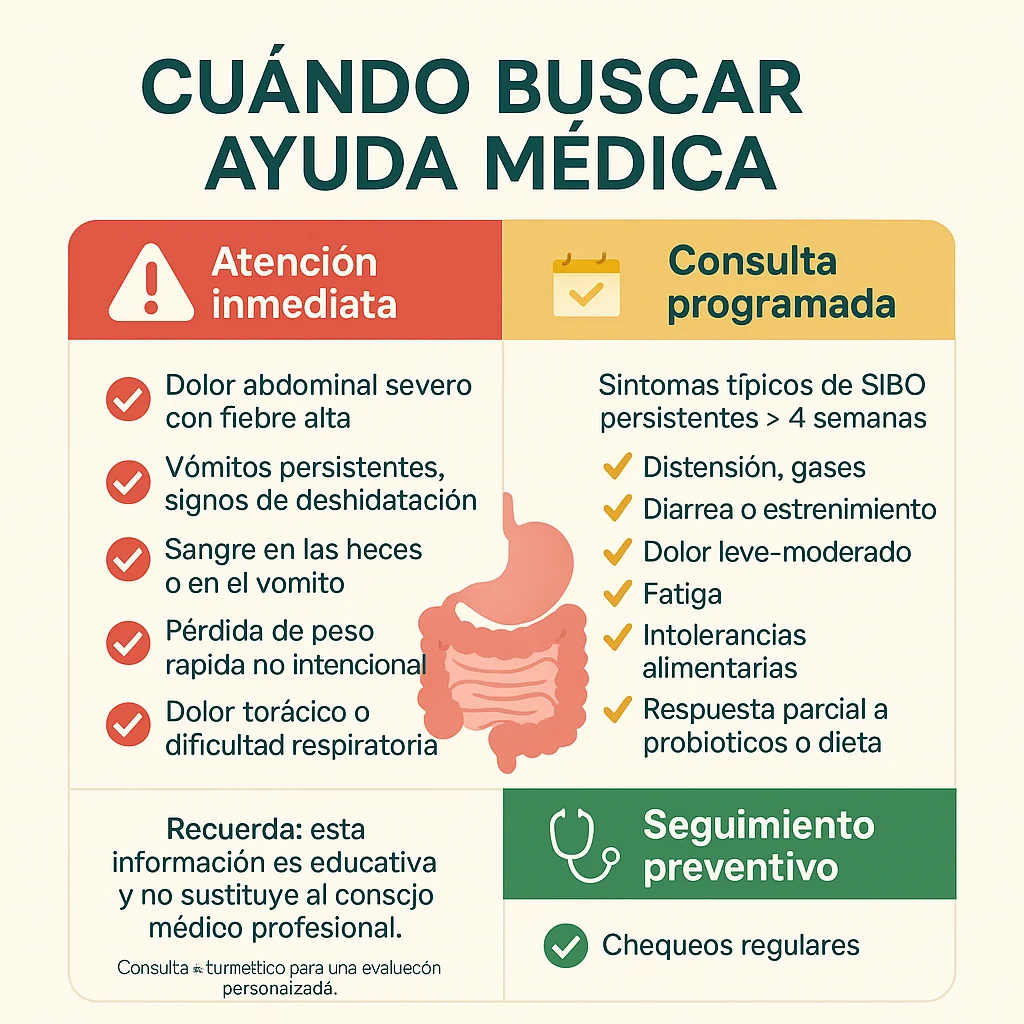
💡 When should you see a doctor about digestive symptoms?
Right away (emergency care) if there is blood in your stool or vomit, sudden or severe abdominal pain, a hard and very painful belly, or you can't pass stool or gas. Soon, with a doctor, if there is unintentional weight loss, iron-deficiency anemia, difficulty swallowing, symptoms that wake you at night, an abdominal mass, or a new and persistent change in bowel habit in an older person. These signs should not be attributed to SIBO or IBS without first ruling out other causes.
Digestive Red Flags: When to See a Doctor
Bloating, gas, diarrhea, constipation, or abdominal pain show up for a huge range of reasons, and the vast majority are not serious. The problem is the other side of that coin: certain signs—the ones gastroenterology calls “red flags” or alarm features—should not be assumed to be “just my SIBO” or “the same old IBS,” because clinical guidelines use them precisely to decide when something else needs to be ruled out.
This guide doesn’t diagnose anything or decide how urgent your individual case is. It does one thing, which is the thing I struggled to find laid out well: it gathers the red flags that clinical sources describe and groups them by level of urgency, so you know what not to wait on.
Author’s note: I’m not a doctor; I’m a developer, and I built this site when my sister was diagnosed with SIBO. Supporting her through that process, what worried me most wasn’t the typical symptoms but the underlying doubt: “this thing she’s feeling—is it part of the picture, or is it something that should be looked at right now?” That boundary—what is day-to-day noise and what is a signal that shouldn’t be normalized—almost never showed up explained in a single place. So I wrote this guide the way it would have helped me to have it back then. I don’t describe any of her specific symptoms; I summarize what the guidelines say for anyone caught in that same doubt.
How to read this: three levels of urgency
Clinical sources don’t treat all signs the same. It helps to separate them into three tiers, from most to least urgent:
| Level | What it means | What to do |
|---|---|---|
| 🔴 Emergency | Potentially acute situation (bleeding, obstruction, acute abdomen) | Emergency services now |
| 🟠 Evaluate soon | Red flags the guidelines use to rule out an organic cause | A medical appointment without delay |
| 🟡 Lower threshold | Personal context that narrows the room to experiment on your own | Ask for guidance before restricting or supplementing |
No single sign “diagnoses” anything on its own. Its value is that it changes the reasonable course of action: stop assuming and ask someone to take a look.
🔴 Level 1 — Seek emergency care now
The British health service (NHS) lists, for stomach pain, specific reasons to seek immediate emergency care. They apply to any digestive symptom, not just pain:
- Blood in your vomit, or vomit that looks like “coffee grounds.”
- Blood in your stool, or stool that is black, sticky, and very foul-smelling (melena).
- Sudden or severe abdominal pain.
- The abdomen hurts a lot when touched (a rigid, very tender belly).
- You can’t pass stool or gas.
- Abdominal pain together with chest pain or difficulty breathing.
- If you have diabetes and are vomiting, or someone has fainted.
On top of this, for difficulty swallowing (dysphagia), Cleveland Clinic points out: go to the emergency room if something gets stuck and you struggle to breathe, or with sudden muscle weakness or paralysis and an inability to swallow. Dysphagia that recurs—even when it isn’t an emergency—should always be evaluated.
These situations are not “decompensated SIBO.” They are scenarios where the priority is to rule out bleeding, an obstruction, or an acute abdomen. This is not the moment for internet lists.
🟠 Level 2 — Evaluate soon, don’t assume SIBO or IBS
This is the heart of the guide. SIBO and IBS can present with bloating, gas, and changes in transit, but gastroenterology guidelines describe a set of red flags that, when they appear, require ruling out other causes before settling on a functional diagnosis.
The American College of Gastroenterology (ACG) and the British NICE guideline agree on much of the list:
- Blood in the stool that isn’t explained by hemorrhoids.
- Unintentional and unexplained weight loss. (The guidelines describe it qualitatively; they don’t set a specific number of pounds.)
- Iron-deficiency anemia with no clear cause.
- Nocturnal diarrhea, or symptoms that wake you at night.
- An abdominal or rectal mass found on examination.
- A family history of colorectal cancer, inflammatory bowel disease, or celiac disease.
When it comes to colonoscopy, it’s worth not confusing two things that serve different purposes: it is used to rule out organic disease in people with red flags, and separately there are age-based colorectal cancer screening programs, whose ranges are defined by each country’s screening guidelines. These are two distinct reasons, not a single threshold; check what age corresponds to screening in your health system.
NICE also stresses a point related to age: a new and persistent change in bowel habit in an older person should not be assumed to be functional without assessing it, and it points the referral decision toward the suspected-cancer pathways. The exact thresholds for age and duration vary by guideline and country, so the sensible course is to seek evaluation when a change like this appears, not to work out the cutoff on your own.
The presence of a red flag does not exclude that it may ultimately be IBS—the ACG itself makes this clear—but it does indicate that you have to look first. That’s why the NIDDK lists, among the signs that point to “something other than IBS,” precisely rectal bleeding, black and tarry stools, anemia, and weight loss.
Other “non-urgent, but see a doctor” situations that also justify an appointment:
- Diarrhea, constipation, pain, or distension that persists for several weeks, or bloating that doesn’t go away or that keeps coming back.
- Difficulty swallowing that recurs (dysphagia), even without choking.
- Nutritional deficiencies, persistent fatigue, or low body weight.
- Needing to restrict more and more foods to feel functional.
- You already have a diagnosis, but the pattern changed or stopped responding the way it used to.
In these cases, evaluation helps decide whether to review diet, transit, medication, or testing. The NIDDK mentions, depending on the context, blood tests (anemia, infection, celiac disease), stool tests, a hydrogen breath test, upper endoscopy with biopsy to rule out celiac disease, and colonoscopy to exclude colon cancer or inflammatory bowel disease.
🟡 Level 3 — When your threshold to seek care should be lower
Some people have less room to experiment on their own. This isn’t about an emergency, but about asking for guidance before starting restrictions, supplements, or changes to your routine:
- Pregnancy, breastfeeding, or trying to conceive.
- Low body weight, recent weight loss, or difficulty maintaining intake.
- A history of an eating disorder or intense anxiety around food.
- Diabetes, kidney, liver, or heart disease, immunosuppression, or active cancer.
- Use of anticoagulants, immunosuppressants, or recent antibiotics.
- Extremes of age: girls, boys, adolescents, or older adults with new symptoms.
This list doesn’t let you calculate severity over the internet. Just remember that personal context changes the level of caution that’s reasonable.
If you’re thinking about SIBO or IBS
SIBO and IBS share symptoms, but they can’t be reliably told apart from a list of complaints. Before comparing the two pictures, it’s worth having ruled out the Level 2 red flags. If you want to dig into the difference, start with SIBO vs. IBS; if the problem keeps coming back in relapses, it can help to review the factors associated with SIBO.
The SIBO breath test adds information in some contexts, but it doesn’t replace the clinical history, the examination, or the review of alarm signs. A positive test does not cancel out a red flag.
Before restricting more foods
When symptoms become persistent, a lot of people start cutting out foods one by one. Sometimes it brings temporary relief, but it can also end in a very limited diet that’s hard to sustain and carries nutritional risk. Before expanding restrictions, review:
- whether the elimination has a defined goal and duration,
- whether there is a reintroduction plan,
- whether you’re covering energy, protein, fiber, and micronutrients,
- whether the fear of eating is growing faster than diagnostic clarity,
- whether there are alarm signs that should be evaluated first.
Diet is a tool, not the automatic answer to any digestive symptom.
What to bring to the appointment
A short summary makes the visit far more useful. Prepare:
- when the symptoms started and whether there was an infection, travel, surgery, or a medication change,
- the frequency and form of your bowel movements,
- their relationship to meals, menstrual cycle, sleep, stress, or physical activity,
- recent weight loss or gain,
- medications, supplements, and diets you’ve already tried,
- results of blood tests, endoscopies, colonoscopies, imaging, or prior tests.
A 7-to-14-day log can help, as long as it stays simple and doesn’t increase anxiety.
Disclaimer. This guide is educational and summarizes public sources; it does not diagnose, does not decide how urgent your individual case is, and does not replace assessment by health professionals or emergency services. It was written by a non-physician author based on the clinical guidelines cited below.
References
- Lacy BE, Pimentel M, Brenner DM, et al. ACG Clinical Guideline: Management of Irritable Bowel Syndrome. Am J Gastroenterol. 2021;116(1):17-44. PDF — gi.org
- National Institute for Health and Care Excellence (NICE). Irritable bowel syndrome in adults: diagnosis and management (CG61) — Recommendations. nice.org.uk
- National Institute of Diabetes and Digestive and Kidney Diseases (NIDDK). Diagnosis of Irritable Bowel Syndrome. niddk.nih.gov
- National Health Service (NHS). Stomach ache — when to get help (999 / 111 / GP). nhs.uk
- Cleveland Clinic. Dysphagia (Difficulty Swallowing): When to seek care. my.clevelandclinic.org
Important editorial note
This information is for educational purposes only and does not replace individualized professional advice. Always discuss decisions about your health with a qualified professional.
Sources and references
These references guide how this piece is written and updated. They do not replace individual clinical assessment.
Reference1
ACG Clinical Guideline: Management of Irritable Bowel Syndrome (2021)Guía clínica para evaluación y manejo de SII, útil para comparar límites entre SII y SIBO.
Reference2
NIDDK: Diagnosis of Irritable Bowel SyndromeRecurso institucional para criterios, evaluación y señales que requieren descartar otras causas.
Reference3
NIDDK: Symptoms & Causes of DiarrheaRecurso institucional sobre señales digestivas y cuándo consultar.
Reference4
Mayo Clinic: Abdominal pain, when to see a doctorResumen clínico público sobre dolor abdominal y señales que ameritan evaluación.
Beiker Guillen
Founder of Sibo Wise
I'm not a health professional — I'm a software developer. I started Sibo Wise when my sister was diagnosed with SIBO and I saw how hard it was to find clear, trustworthy information. My role here is research and organization: I gather what serious medical sources say —clinical guidelines from the ACG and AGA, Monash University materials, and PubMed-indexed studies— and cross-check every claim against its original source before publishing.
This content does not replace professional medical advice. If you have any concerns about your health, consult a qualified gastroenterologist or dietitian.