SIBO Breath Test: Complete Guide
How the SIBO breath test works, what it can contribute, how to prepare, and why the results always need clinical context.
Editorial standards for this guide
Editorial lead
Beiker Guillen
Published
Last updated
Last editorial review
This content is for educational purposes. It summarizes public evidence, explains it in plain English, and avoids closed recommendations when the literature is uncertain or depends on clinical context.
You can review how we select sources, how we update older pieces, and the editorial limits we follow in our editorial methodology .
Quick Summary (TL;DR)
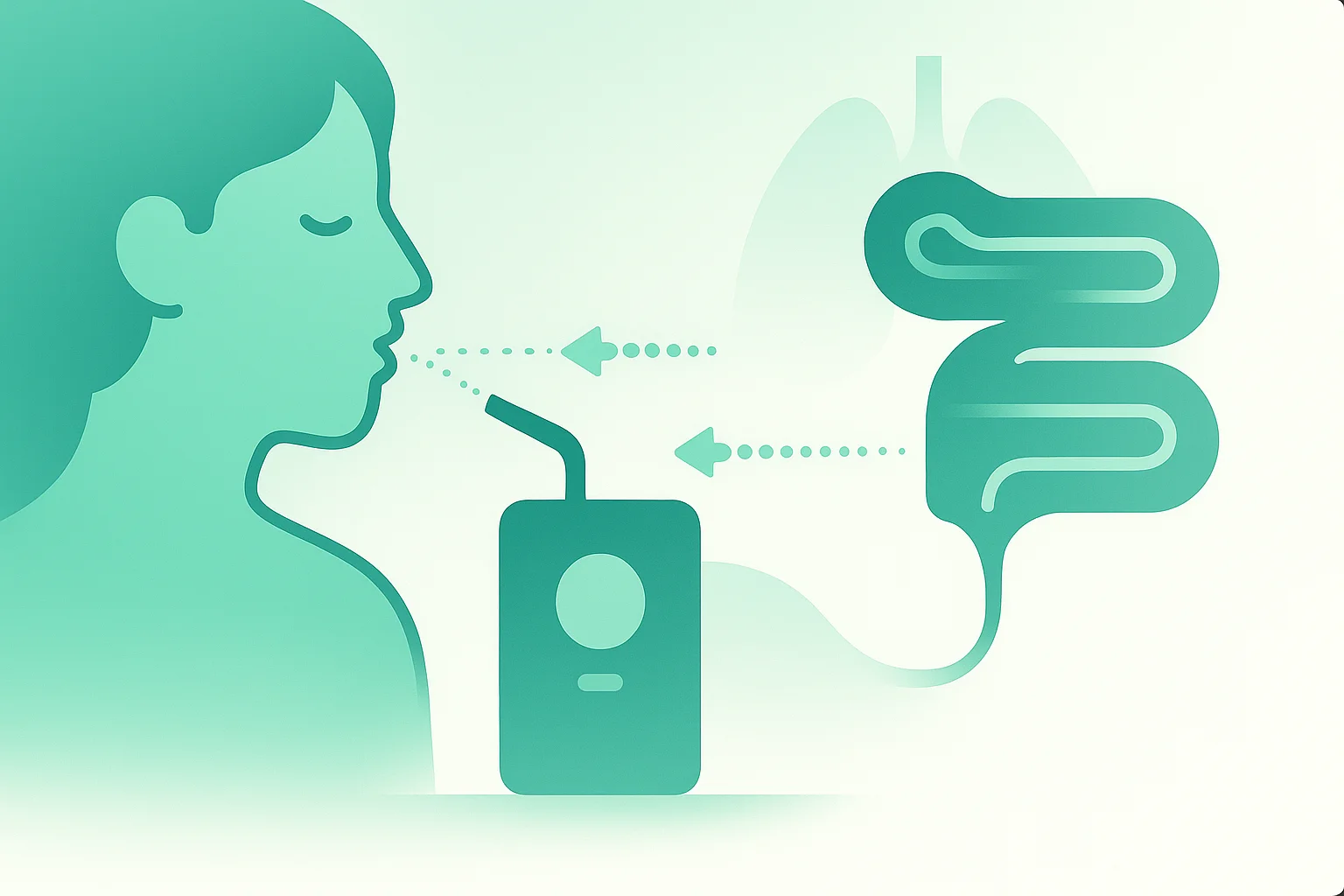
- What is it?: a non-invasive test that measures hydrogen and/or methane in the breath after ingesting a substrate such as lactulose or glucose.
- The most important point: its usefulness depends on correct preparation and a careful clinical interpretation; it is not a perfect test.
- What you’ll take away: how to prepare, what differences there are between lactulose and glucose, what the results mean, and what their limits are.
💡 How is SIBO evaluated with a breath test?
The SIBO breath test measures the rise in hydrogen and/or methane after ingesting lactulose or glucose. It can provide useful information, but it must be interpreted together with the symptoms, the prior preparation, the protocol used, and the clinical context.
SIBO Breath Test: Complete Guide
The breath test is one of the most widely used non-invasive tests for investigating SIBO (Small Intestinal Bacterial Overgrowth) [1][2]. This guide explains how it works, what it can contribute, what limits it has, and why the results need clinical context.
Author’s note: The breath test is one of the tests that generates the most confusion. When I first researched this topic, I found contradictory interpretations even among recognized medical sources. This guide tries to present what there is consensus about and to clearly mark where the evidence is less clear.
⚠️ IMPORTANT: This guide is informational and educational. The breath test should be ordered, supervised, and interpreted by a specialist physician (gastroenterologist). Do not attempt to self-diagnose or interpret results without professional medical supervision. The test results must be evaluated together with your symptoms, medical history, and other tests to obtain an accurate diagnosis.
In this guide: you’ll see how the test works, what it really measures, how to prepare to reduce errors, and why its results should not be read in isolation.
What this test can contribute
- It can give guidance on whether there is early fermentation compatible with SIBO or IMO in the right context.
- It helps standardize the clinical discussion when a well-prepared protocol is used.
- It can offer clues about the predominant gas and about the type of follow-up worth discussing.
What it cannot resolve on its own
- It does not automatically confirm that all symptoms are due to SIBO [2].
- It does not completely rule out other digestive causes if it comes back negative [1].
- It does not eliminate the risk of false positives or false negatives.
- It does not replace the clinical history, the physical examination, or other tests when the case is complex.
What Is the Breath Test and How Does It Work?
Basic concept
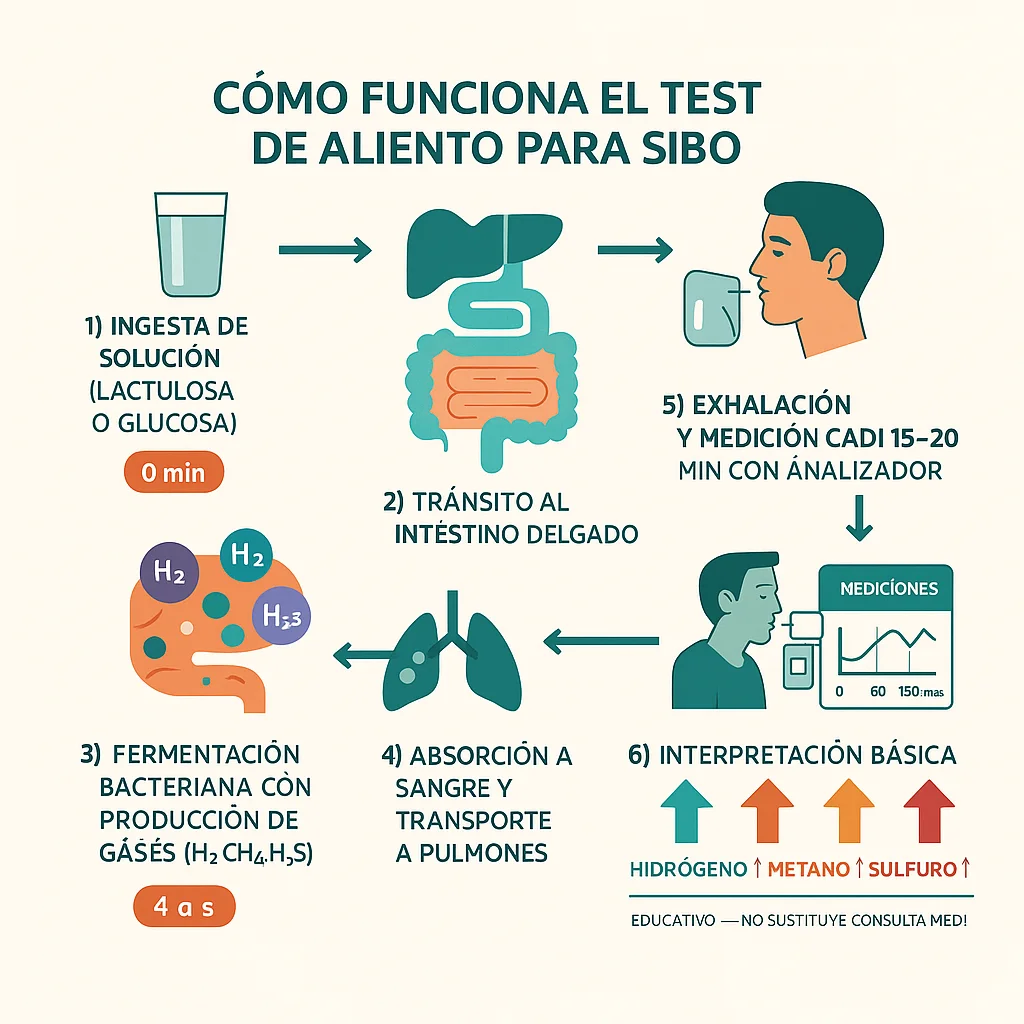
The SIBO breath test is a non-invasive test that measures the gases (hydrogen, methane, and/or hydrogen sulfide) that bacteria produce in the small intestine when they ferment carbohydrates [3][4].
How the process works
1. Ingestion of a sugar solution:
- You consume a solution containing a specific type of sugar (lactulose or glucose)
- This solution reaches the small intestine
2. Bacterial fermentation:
- If there is bacterial overgrowth in the small intestine, the bacteria ferment the sugar
- This fermentation produces gases as a byproduct:
- Hydrogen (H2): Produced by many bacteria
- Methane (CH4): Produced by methanogenic archaea
- Hydrogen sulfide (H2S): Produced by certain sulfur-reducing bacteria
3. Absorption and exhalation:
- These gases are absorbed into the bloodstream
- They travel to the lungs
- They are exhaled in the breath
4. Measurement:
- The levels of these gases in your breath are measured at regular intervals
- Elevated levels indicate bacterial fermentation in the small intestine
Why Is the Breath Test Used?
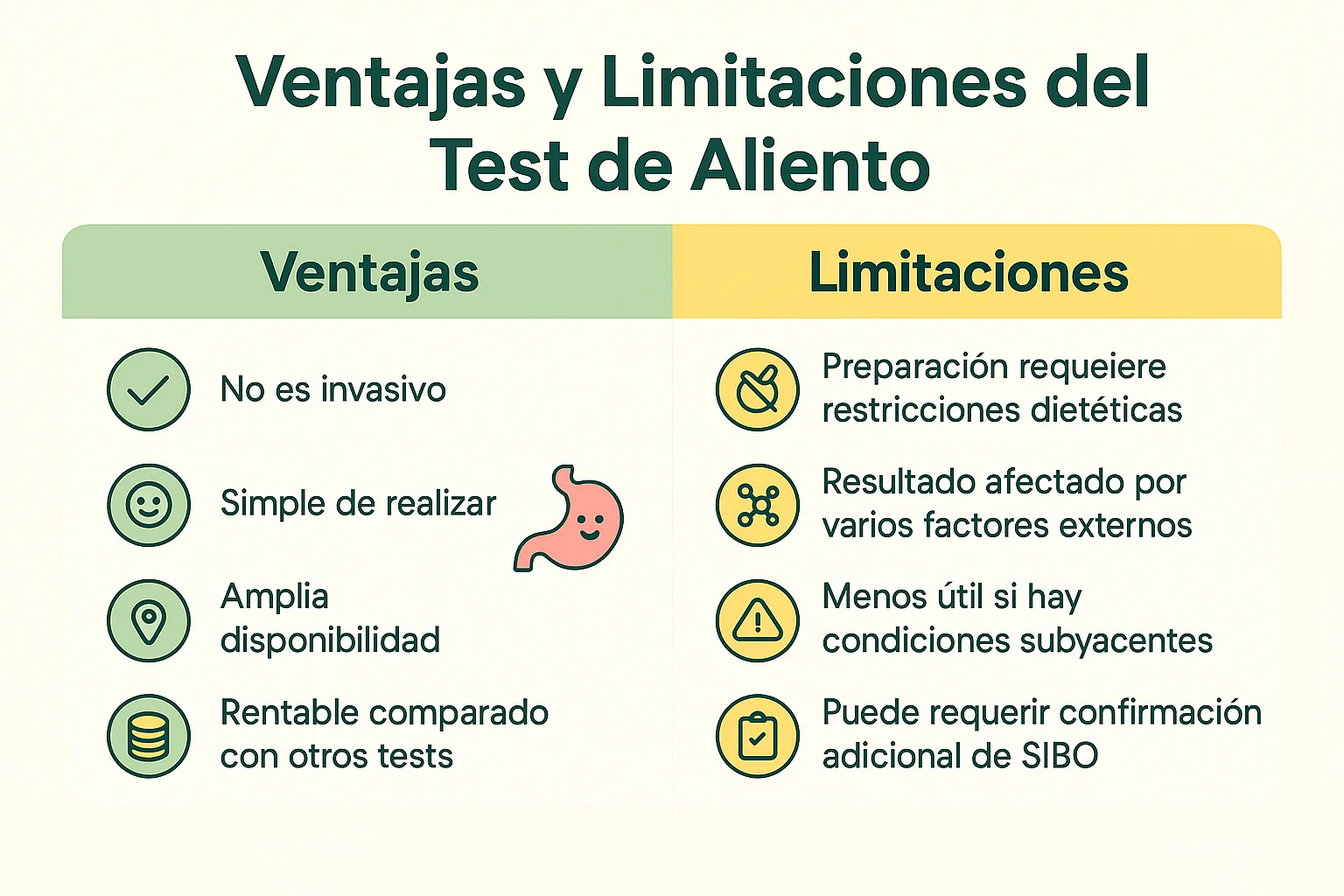
Advantages of the breath test
Non-invasive:
- It does not require invasive procedures such as endoscopies
- It does not require anesthesia
- Relatively comfortable for the patient
Accessible:
- Available in many laboratories and clinics
- Some laboratories offer kits to do it at home (under medical supervision)
- Generally more affordable than invasive procedures
Orienting information:
- It can give guidance on hydrogen, methane, or hydrogen sulfide patterns
- It helps you discuss the digestive context with your treating team
- It should not be interpreted in isolation
Safe:
- Very few side effects
- Generally well tolerated
- No exposure to radiation
Limitations of the test
One point worth mentioning is that, despite being the most widely used test, the breath test is not perfect. The most recent clinical guidelines openly acknowledge this [1][2], and understanding these limitations helps interpret the results with better judgment.
It is important to understand that the breath test has some limitations:
Possible false positives:
- If intestinal transit is very fast, the sugar may reach the colon too early
- The colon bacteria can ferment the sugar, giving results that look like SIBO
- Certain conditions can affect the results
Possible false negatives:
- If there are severe motility problems, the sugar may not reach the small intestine properly
- If the bacteria do not ferment the type of sugar used in the test
- If the preparation was not followed correctly
Variability between laboratories:
- Different laboratories may use different protocols
- Interpretation may vary slightly
- It is important to use a reliable and experienced laboratory
It does not detect all bacteria:
- It only detects bacteria that produce measurable gases
- Some bacteria may not produce these gases
- It may not detect all types of overgrowth
⚠️ IMPORTANT: Despite its limitations, the breath test remains one of the most widely used non-invasive tools to guide the evaluation of SIBO. The results must be interpreted within the clinical context and the protocol used.
Types of Breath Test
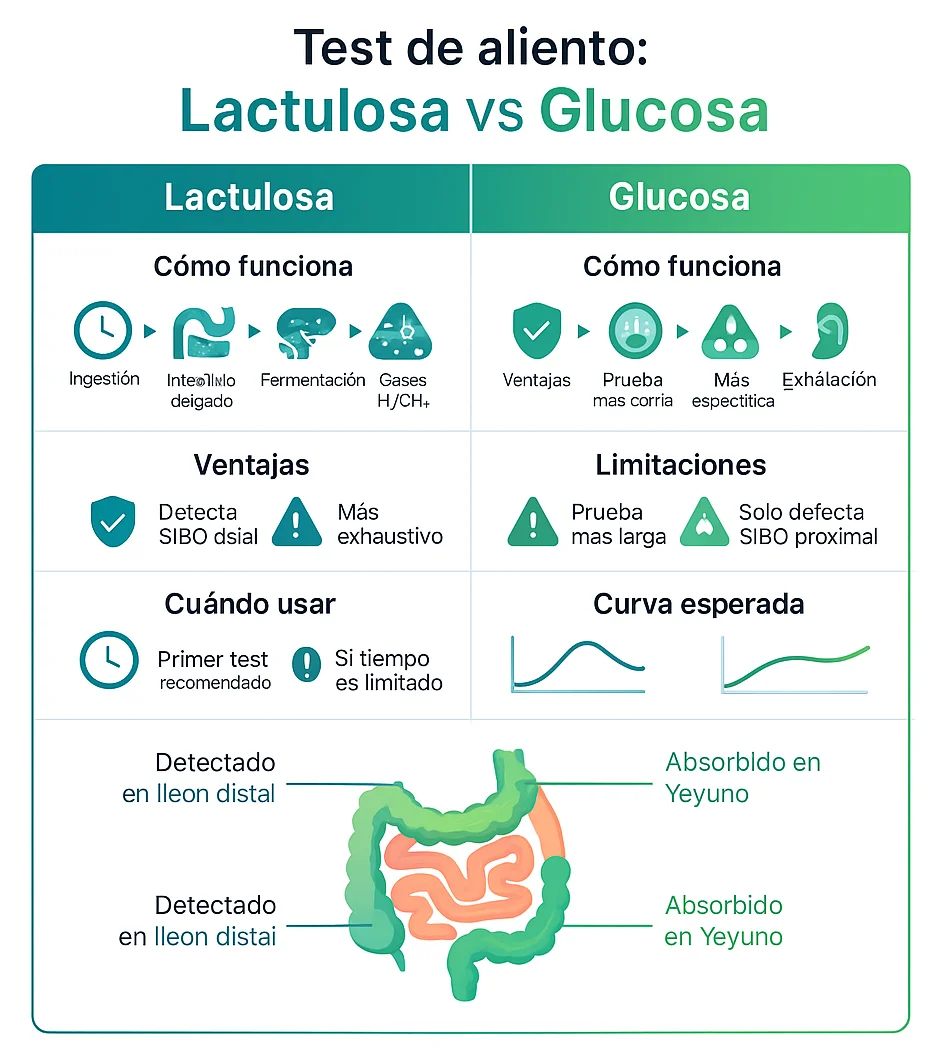
There are different types of breath test, each with its own characteristics:
Lactulose Test
What it is:
- A solution of lactulose (a non-absorbable sugar) is administered
- Lactulose is not digested by the human body
- Only bacteria can ferment it
How it works:
- Lactulose passes through the stomach without being absorbed
- It reaches the small intestine, where bacteria can ferment it
- If there is SIBO, the bacteria ferment the lactulose and produce gases
- The lactulose continues toward the colon, where the colon bacteria also ferment it
Advantages:
- It detects SIBO throughout the entire small intestine (proximal and distal) [1]
- It can detect overgrowth in different parts of the small intestine
- Useful for cases where SIBO may be lower down in the intestine
Disadvantages:
- It can produce false positives if intestinal transit is very fast
- It can be difficult to distinguish between fermentation in the small intestine vs. the colon
- It can cause more symptoms during the test (diarrhea, gas)
When it is used:
- When SIBO is suspected anywhere in the small intestine
- When other tests have been negative but the symptoms suggest SIBO
- For a complete evaluation of the small intestine
Glucose Test
What it is:
- A solution of glucose (an absorbable sugar) is administered
- Glucose is normally absorbed quickly in the upper part of the small intestine
How it works:
- Glucose is absorbed quickly in the upper part of the small intestine
- If there is SIBO in this area, the bacteria ferment the glucose before it is absorbed
- This produces gases that can be measured
- If there is no SIBO, the glucose is absorbed before reaching bacteria
Advantages:
- More specific for the proximal small intestine (upper part) [1][3]
- Less likelihood of false positives from colon fermentation
- Generally causes fewer symptoms during the test
Disadvantages:
- It may not detect SIBO in the distal small intestine (lower part)
- If the SIBO is lower down in the intestine, it may give a negative result
- The rapid absorption of glucose can limit detection
When it is used:
- When SIBO is suspected in the upper part of the small intestine
- When the lactulose test gave ambiguous results
- For confirmation in specific cases
Hydrogen Sulfide Test
What it is:
- Some laboratories can measure hydrogen sulfide in addition to hydrogen and methane
- It detects sulfur-reducing bacteria
When it is used:
- When hydrogen sulfide-dominant SIBO is suspected
- When the symptoms suggest this specific type of SIBO
- For a complete evaluation of all types of gases
Preparation for the Test: Detailed Guide
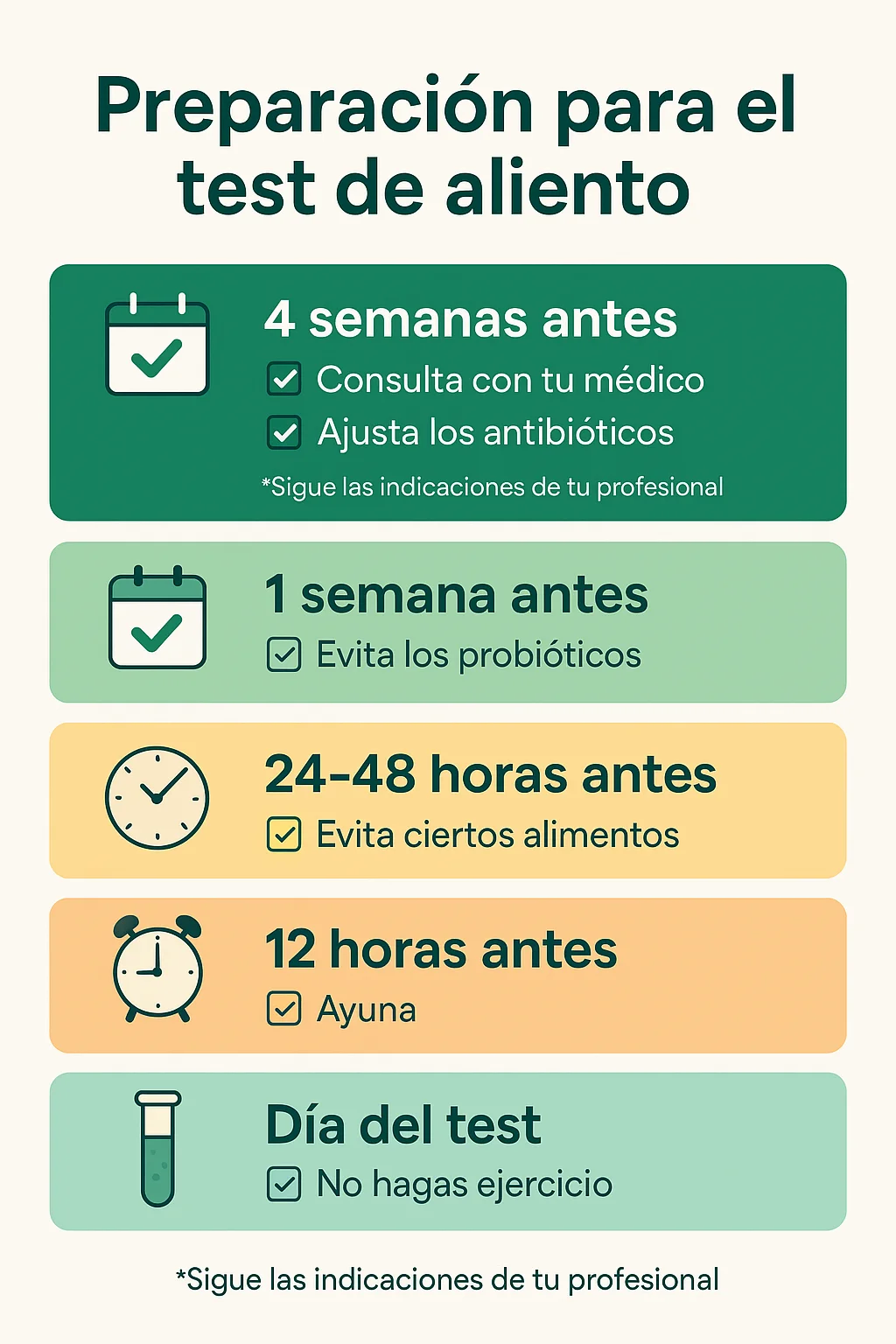
Proper preparation is crucial for obtaining accurate results [3][4]. If the preparation is not followed correctly, the results may be inaccurate.
Something I found difficult to summarize is that preparation instructions vary considerably between laboratories and between clinical guidelines. The North American Consensus [3] and the European guideline [4] agree on the essential points, but they differ on some minor details. What I present here are the most common and widely accepted recommendations.
Why is preparation so important?
Eliminate interferences:
- Certain foods, medications, and activities can affect the results
- Colon bacteria can interfere if there are food residues
- Medications can affect the bacteria or motility
Establish an accurate baseline:
- Fasting aims to reduce fermentation of recent foods
- It allows measuring only the fermentation of the test sugar
- It provides a reliable baseline for comparison
Maximize accuracy:
- Proper preparation maximizes the chances of detecting SIBO if it is present
- It reduces the likelihood of false positives or negatives
- It helps make the results more interpretable
Preparation: 4 weeks before the test
Medications or products that can have an effect:
- Antibiotics.
- Probiotics.
- Laxatives.
- Medications that affect motility.
⚠️ IMPORTANT: Do not stop or modify medications based on this guide. Follow the instructions of your physician or laboratory, because some recommendations change depending on the case.
Preparation: 1 week before the test
Special diet:
- Some physicians may recommend a specific diet
- Generally, foods that can cause excessive fermentation are avoided
- Follow the specific instructions of your physician or laboratory
Your laboratory may ask you to avoid:
- Highly fermentable foods
- Carbonated drinks
- Alcohol
- Supplements or products that may affect the test.
Preparation: 24-48 hours before the test
Medications and supplements:
- Follow only the instructions given to you by your physician or laboratory.
- Report all the medications and supplements you take.
- Do not change treatments on your own.
Activities:
- Avoid intense exercise
- Keep a regular sleep schedule
- Reduce stress as much as possible
Preparation: 12 hours before the test
Complete fasting:
- Do not eat anything during the 12 hours before the test [3][4]
- Only water is allowed (no carbonation, no flavorings)
- You can drink water up to 1 hour before the test (check specific instructions)
Prohibited activities:
- Do not smoke (smoke can affect the results)
- Do not chew gum (it can cause fermentation)
- Do not do intense exercise
- Do not sleep during the fasting period (it can affect motility)
Medications:
- Take only essential medications approved by your physician
- With water only
- Inform the technician about any medication you have taken
Preparation: The day of the test
Morning time:
- The test is generally performed in the morning after the overnight fast
- Arrive at the laboratory with time to spare (at least 15 minutes early)
- Bring identification and any required documentation
Oral hygiene:
- Brush your teeth with water only (no toothpaste)
- Toothpaste can contain ingredients that affect the results
- Do not use mouthwash (it can contain ingredients that interfere)
- Do not use mints or candy before the test
Comfortable clothing:
- Wear comfortable clothing since you will be seated for 2-3 hours
- Bring something to read or for entertainment (book, magazine, device)
- Some laboratories may have WiFi or television
What to bring:
- Identification
- Relevant medical documentation
- List of medications you are taking
- Symptom diary (if you keep one)
- Something for entertainment during the wait
Test Procedure: What to Expect
Arrival at the laboratory
Registration:
- You will register at the laboratory
- You will provide information about your preparation
- The technician will review the instructions with you
- There may be a form about symptoms and preparation
Initial assessment:
- The technician may ask you questions about:
- Your preparation (what you ate, when your last meal was)
- Medications you have taken
- Current symptoms
- Relevant medical history
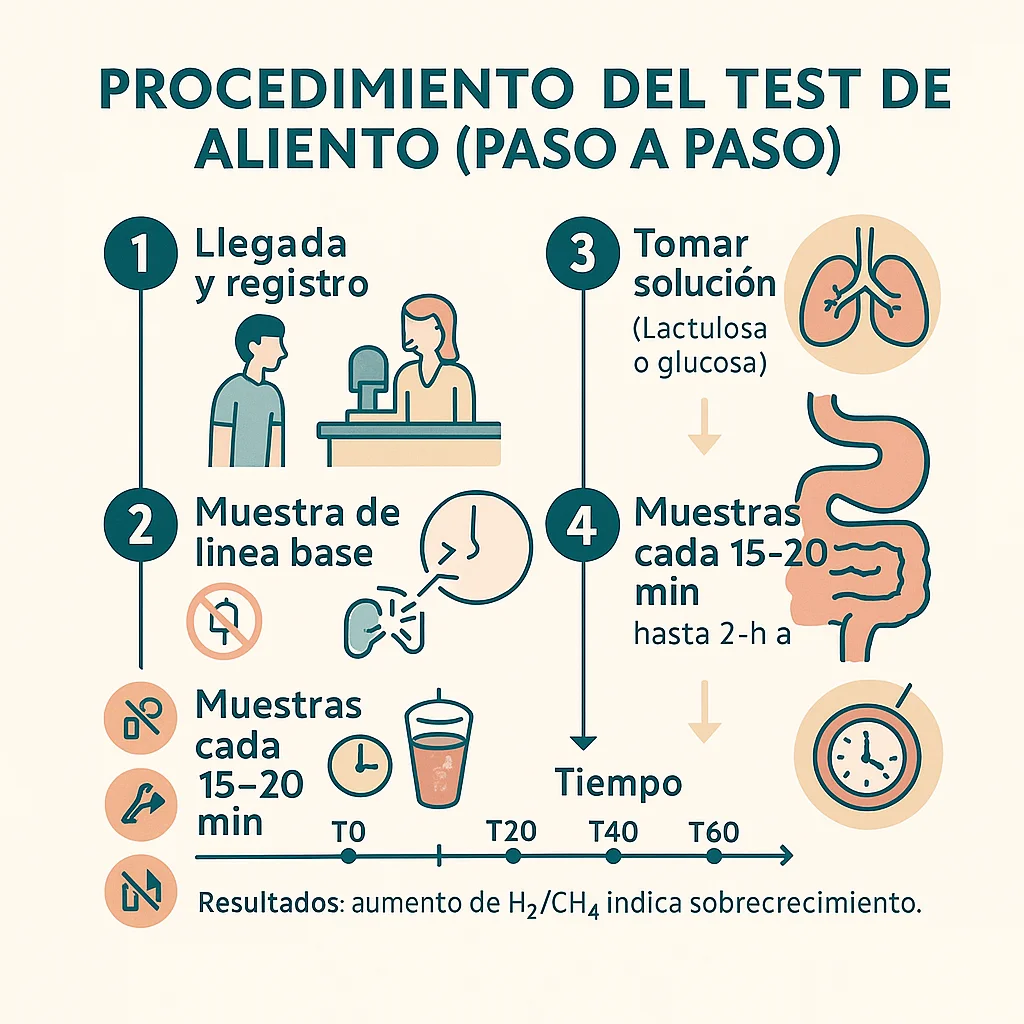
Step 1: Baseline sample
What it is:
- An initial breath sample is taken before consuming the solution
- This sample establishes your “normal” level of gases
- It is used as a reference point to compare the later samples
How it is done:
- You will be asked to blow into a special device
- It can be a bag, a tube, or an electronic device
- The technician will give you specific instructions on how to blow
- It may require you to hold your breath briefly before blowing
Importance:
- This baseline is crucial for interpreting the results
- If the initial levels are high, it may indicate problems
- The technician may repeat this sample if there are doubts
Step 2: Consuming the solution
What you will receive:
- A solution containing lactulose or glucose (depending on the type of test)
- It is generally a sweet liquid
- The amount is specific according to the laboratory’s protocol
How to consume it:
- You will be asked to drink it completely
- It is generally consumed quickly
- It may taste sweet or slightly unpleasant
- It is important to consume all of it according to the instructions
After consuming it:
- You cannot eat or drink anything else during the test
- Only water may be allowed (check specific instructions)
- You cannot smoke or chew gum
Step 3: Periodic breath samples
Frequency:
- Breath samples will be taken every 15-20 minutes [3]
- This continues for 2-3 hours (depending on the protocol) [4]
- The technician will tell you when it is time for each sample
Process of each sample:
- You will be asked to blow into the device
- It may require a specific technique (blow gently, hold your breath, etc.)
- The technician will guide you through each sample
- Each sample is labeled with the time since you consumed the solution
Symptom log:
- During the test, the technician may ask you about symptoms
- You may be asked to record any symptoms you experience
- It is normal to experience symptoms similar to those you usually have
- The symptoms during the test can be useful information for the diagnosis
What to do during the test
Allowed:
- Read, use electronic devices (if permitted)
- Talk with the technician if you have questions
- Drink water (if permitted according to the protocol)
- Use the bathroom if necessary (inform the technician)
Not allowed:
- Eat or drink (except water if permitted)
- Smoke
- Chew gum or eat mints
- Sleep (it can affect the results)
- Exercise or physical activity
Symptoms during the test
It is normal to experience:
- Bloating (it may be similar to your usual symptoms)
- Gas
- Mild abdominal pain
- Mild nausea
- Urgency to go to the bathroom
If the symptoms are severe:
- Inform the technician immediately
- The technician can adjust the procedure if necessary
- In very rare cases, the test may be stopped if necessary for safety
Why symptoms occur:
- If you have SIBO, the bacteria will ferment the sugar
- This can cause symptoms similar to those you usually experience
- The symptoms during the test can be useful diagnostic information
Interpretation of Results
Understanding the results
The breath test results show the levels of gases (hydrogen, methane, hydrogen sulfide) measured in your breath over time.
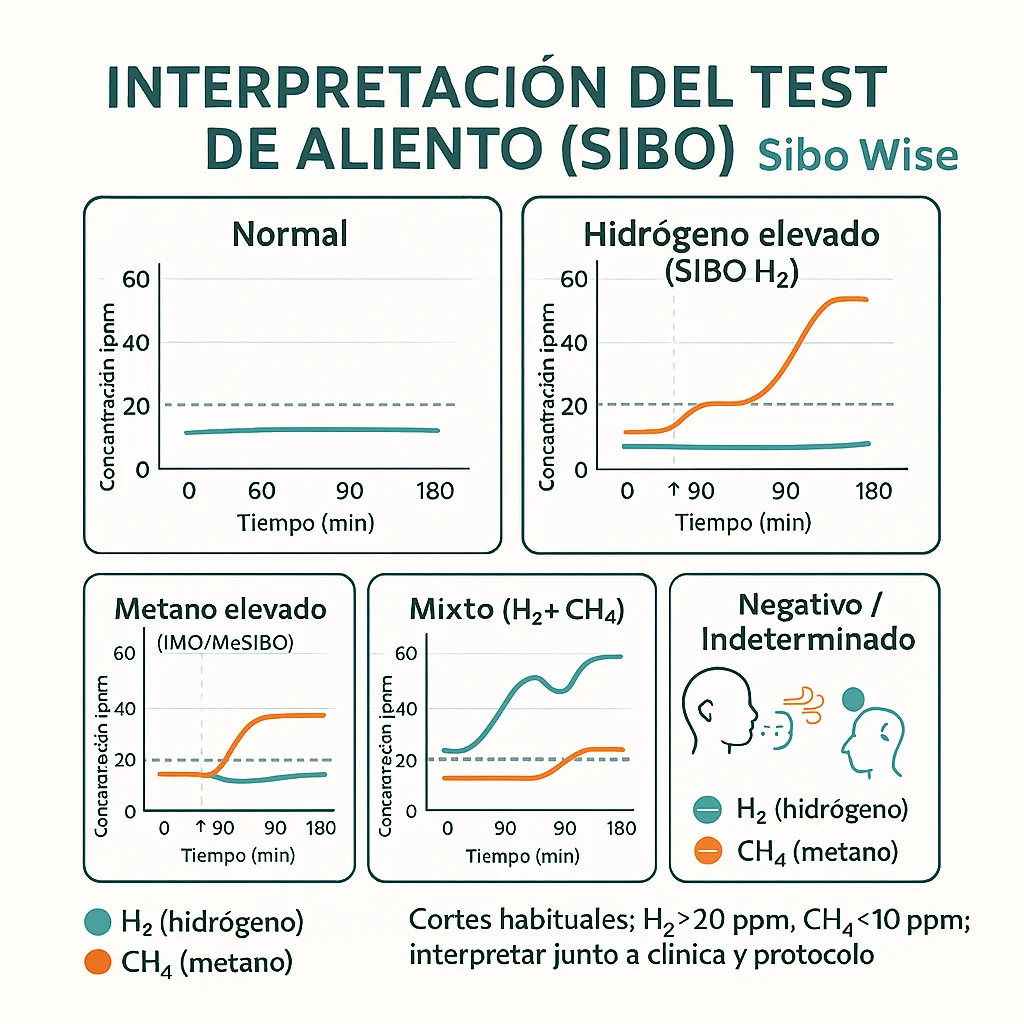
Typical graph:
- X-axis: Time (minutes since consuming the solution)
- Y-axis: Gas levels (ppm - parts per million)
- Different lines for each type of gas
Normal results
Hydrogen:
- Baseline: Generally low (below 20 ppm)
- During the test: It may rise slightly but stays low
- Significant rise: Only after the solution reaches the colon (after 90-120 minutes)
Methane:
- Baseline: Generally very low (below 10 ppm)
- During the test: It stays low throughout the test
- Rise: Only when the solution reaches the colon
Hydrogen sulfide:
- Generally undetectable or very low
- Rise only when the solution reaches the colon
SIBO Positive: Elevated Hydrogen
Diagnostic criteria:
- Rise of ≥ 20 ppm of hydrogen above the baseline [3]
- This rise occurs within the first 90 minutes after consuming the solution [3]
- It indicates fermentation in the small intestine (before reaching the colon)
What it means:
- There is an overgrowth of hydrogen-producing bacteria in the small intestine
- These bacteria are fermenting carbohydrates before they are completely digested
- It can be associated with diarrhea symptoms
Typical pattern:
- Early and rapid rise in hydrogen
- The rise occurs before the solution reaches the colon
- There may be a second rise when the solution reaches the colon
SIBO Positive: Elevated Methane
Diagnostic criteria:
- Methane level ≥ 10 ppm at any point during the test [3]
- It may be elevated from the baseline
- Or it may rise during the test
What it means:
- There is an overgrowth of methanogenic archaea (such as Methanobrevibacter smithii) [1]
- These archaea convert hydrogen into methane
- It can be associated with constipation symptoms
Typical pattern:
- Methane elevated from the start or early in the test
- There may be little or no rise in hydrogen (the archaea convert it into methane)
- Methane may stay elevated throughout the test
SIBO Positive: Elevated Hydrogen Sulfide
Diagnostic criteria:
- A rise in detected hydrogen sulfide
- A specific pattern on the graph
- (The exact criteria can vary by laboratory)
What it means:
- There is an overgrowth of sulfur-reducing bacteria
- These bacteria produce hydrogen sulfide
- It can be associated with severe symptoms and fatigue
Mixed SIBO
What it is:
- When there are multiple types of elevated gases
- For example: hydrogen and methane elevated simultaneously
- Or hydrogen and hydrogen sulfide elevated
What it means:
- There are multiple types of bacteria/archaea present
- It may require a more complex treatment approach
- It must be evaluated by a specialist physician
Negative results
What it means:
- No evidence of bacterial overgrowth in the small intestine was detected
- The gas levels stayed normal during the test
- Fermentation only occurred when the solution reached the colon (normal)
Important considerations:
- A negative result does not completely rule out SIBO
- There can be false negatives for various reasons:
- Motility problems that prevent the solution from reaching the small intestine
- Bacteria that do not ferment the type of sugar used
- Inadequate preparation
- SIBO in the distal small intestine (if glucose was used)
If the test is negative but the symptoms persist:
- Your physician may recommend additional tests
- They may consider other diagnoses
- They may recommend repeating the test under different conditions
- They may evaluate other causes of your symptoms
⚠️ IMPORTANT: The interpretation of the breath test results must be carried out by a specialist physician. The results must be evaluated together with:
- Your symptoms and their pattern
- Your medical history
- Other tests or evaluations
- Specific individual factors
Do not attempt to interpret the results on your own. An experienced physician can consider all the factors and provide an accurate diagnosis.
Factors That Can Affect the Results
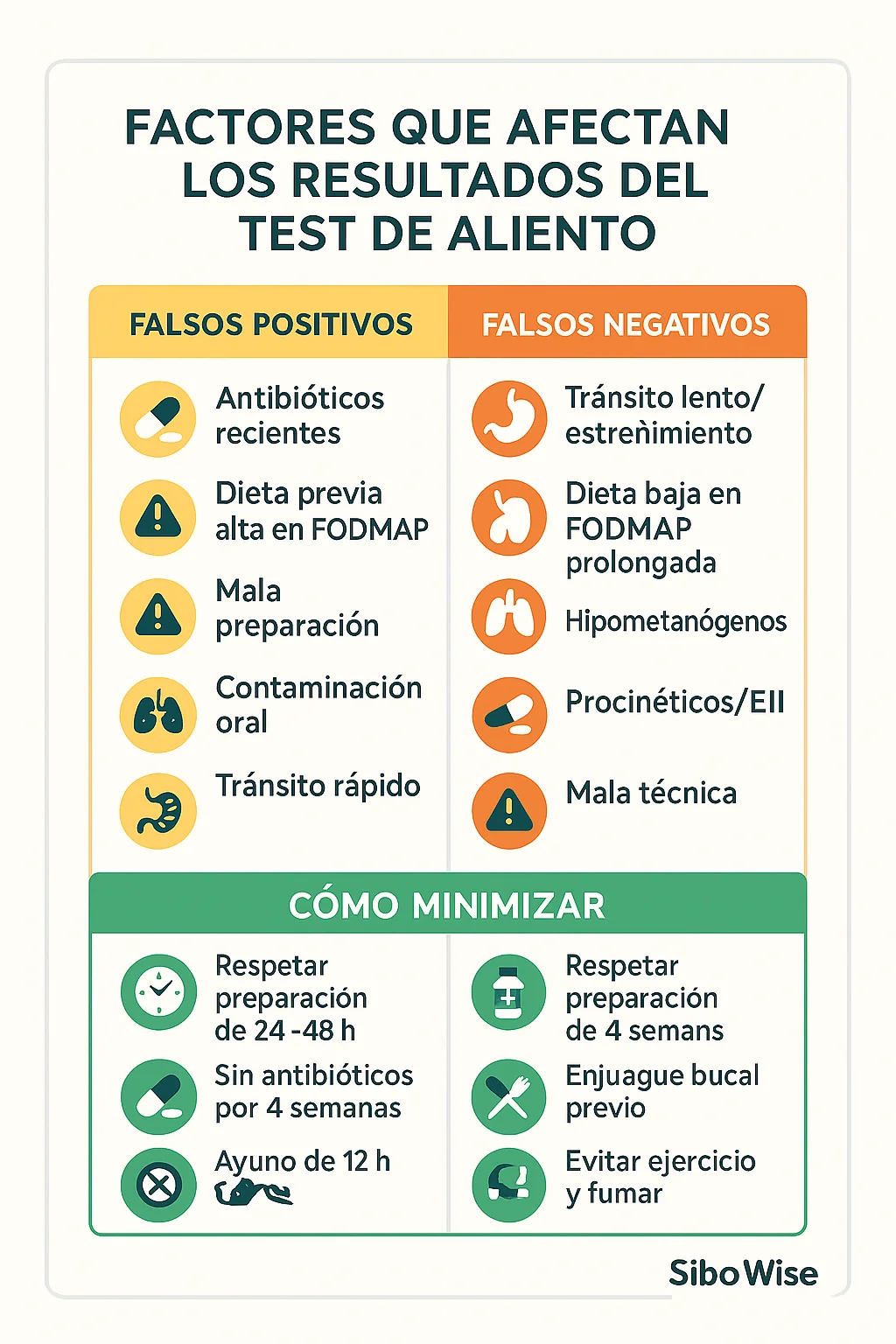
Factors that can cause false positives
Fast intestinal transit:
- If food moves very quickly through the intestine
- The solution may reach the colon too early
- The colon bacteria ferment the solution, giving a false positive result
Inadequate preparation:
- Not following the fast correctly
- Consuming prohibited foods or drinks
- Not stopping medications as instructed
Contamination:
- Smoking before or during the test
- Using products that contain ingredients that interfere
- Not following the oral hygiene instructions
Factors that can cause false negatives
Slow intestinal transit:
- If there are severe motility problems
- The solution may not reach the small intestine properly
- It may give a negative result even if there is SIBO
Type of sugar used:
- If the bacteria do not ferment the type of sugar used
- It may not detect the overgrowth
- That is why more than one type of test is sometimes needed
Inadequate preparation:
- Taking medications that affect the bacteria
- Not following the instructions correctly
- Factors that alter the intestinal environment
SIBO in the distal small intestine:
- If glucose is used and the SIBO is lower down
- The glucose may be absorbed before reaching the SIBO
- It may require a lactulose test to detect it
How to minimize these factors
Follow the preparation carefully:
- Read all the instructions attentively
- Prepare a plan to follow the preparation
- Consult with your physician if you have doubts
- Do not assume you can “cheat” a little
Communication with the physician:
- Report all the medications you take
- Discuss any medical condition that may have an effect
- Ask if there is anything specific you should do or avoid
Choose a reliable laboratory:
- Use a laboratory with experience in SIBO breath tests
- Make sure they follow standard protocols
- Ask about their experience and accuracy
After the Test: What to Expect
Immediately after the test
You can resume normal activities:
- You can eat and drink normally
- You can resume your medications (as medically directed)
- You can exercise
- You can resume your normal routine
Post-test symptoms:
- You may experience some digestive symptoms
- This is normal and usually resolves quickly
- Drink water to help eliminate the solution
- The symptoms should improve within a few hours
If the symptoms persist or are severe:
- Contact your physician if necessary
- There are generally no serious complications
- Mild symptoms are normal and expected
Obtaining results
Waiting time:
- The results are generally available within 1-2 weeks
- Some laboratories may have faster results
- The laboratory will send the results to your physician
Review with your physician:
- Your physician will review the results with you
- They will interpret them in the context of your symptoms and history
- They will discuss the implications and next steps
- They will define the next steps if applicable
Questions to ask your physician:
- What do these results mean specifically for me?
- What type of SIBO do I have (if the test is positive)?
- What management or testing options make sense in my case?
- Do I need additional tests?
- When should I see improvement in the symptoms?
If the test is positive
Possible next steps:
- Your physician may propose follow-up, management changes, or additional studies.
- The results should be reviewed together with symptoms, history, and the limitations of the test.
- It may require follow-up and adjustments.
Expectations:
- The process may take time.
- It may require reviewing several possible explanations.
- Working with your medical team is key.
If the test is negative
Typical next steps:
- Your physician may evaluate other causes of your symptoms
- They may recommend additional tests
- They may consider other diagnoses
- They may recommend repeating the test under different conditions
Don’t get discouraged:
- A negative result does not mean your symptoms are not real
- There may be other causes that need to be evaluated
- Your physician will work with you to find the cause
- It may require further evaluation and testing
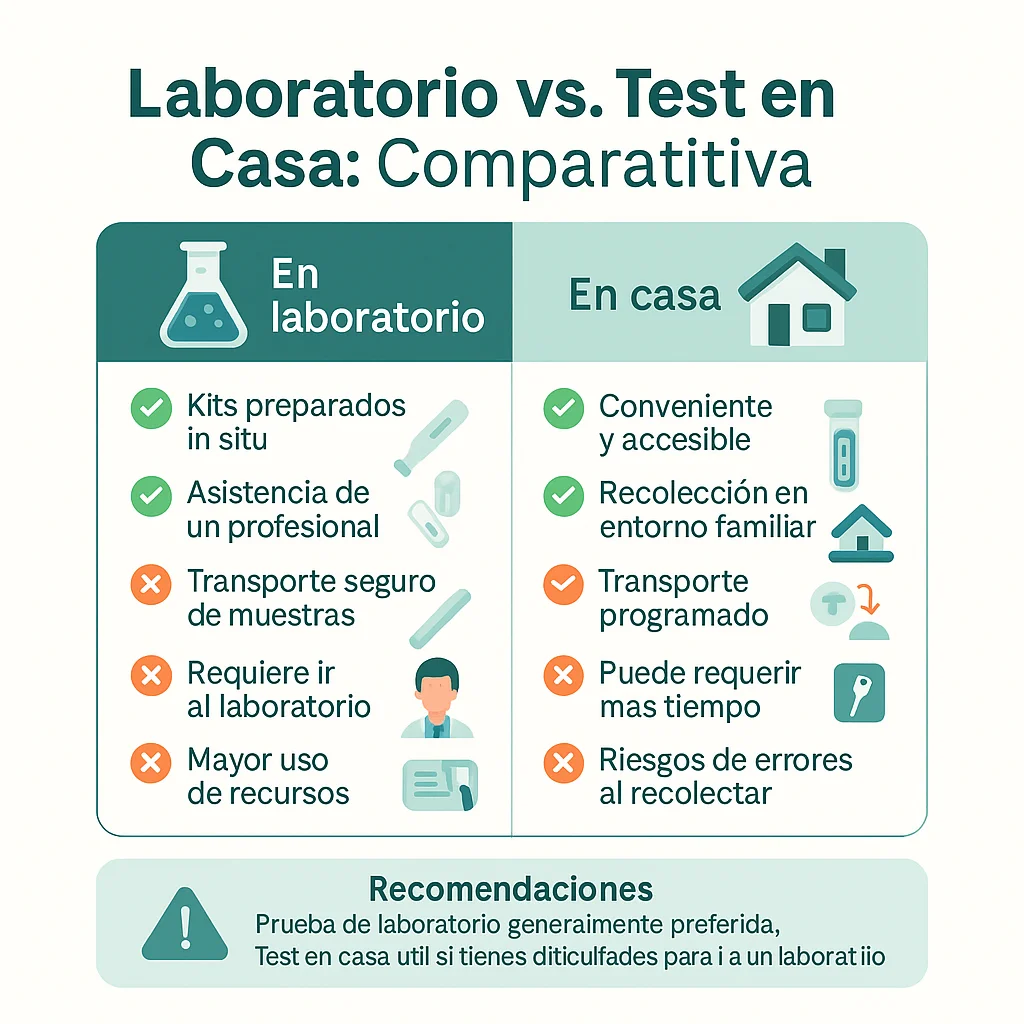
Breath Test at Home vs. Laboratory
Test in a laboratory
Advantages:
- Professional supervision throughout the entire process
- Specialized and calibrated equipment
- A technician available for questions and problems
- Generally greater accuracy
- Standardized protocol
Disadvantages:
- It requires time and travel
- It can be more expensive
- Less convenient
Test at home (home kits)
Advantages:
- More convenient (you can do it at home)
- It can be more affordable
- You can do it on your own schedule
- Less travel time
Disadvantages:
- Less professional supervision
- Greater risk of errors in the preparation or procedure
- It can be less accurate
- It may require mailing in samples
Important considerations:
- If you choose a home kit, make sure it is from a reliable laboratory
- Follow the instructions very carefully
- Consider doing it under medical supervision
- Discuss with your physician whether a home kit is appropriate for you
⚠️ IMPORTANT: Whether you do the test in a laboratory or at home, it is crucial that it be ordered and interpreted by a specialist physician. The results must be professionally evaluated together with your medical history and symptoms.
Frequently Asked Questions
Is the breath test painful?
No, it is completely non-invasive. You only need to blow into a device. There are no needles, invasive procedures, or pain involved. You may experience some digestive symptoms during the test (similar to your usual symptoms), but the procedure itself is not painful.
How long does the complete test take?
The complete procedure generally takes 2-3 hours. This includes:
- Registration and initial preparation: 15-30 minutes
- Baseline sample: 5 minutes
- Consuming the solution: 5 minutes
- Periodic samples for 2-3 hours: 2-3 hours
- Total: Approximately 2.5-3.5 hours
Can I do the test if I am pregnant?
Consult with your physician or obstetrician. During pregnancy the decision must be evaluated case by case. There may be special considerations, or it may be better to wait until after the pregnancy depending on your specific situation.
Can I do the test if I have diabetes?
Yes, it is generally possible, but it is important to:
- Inform your physician about your diabetes
- Discuss how to manage your diabetes during the fast
- It may require adjustments to diabetes medications (under medical supervision)
- Monitor glucose levels during the test
What if I have severe symptoms during the test?
Inform the technician immediately. If you experience severe symptoms during the test:
- The technician can adjust the procedure
- They can stop the test if necessary for safety
- In very rare cases, it may be necessary to stop the test
- Your safety is the priority
Can I take my regular medications before the test?
Consult with your physician. Some medications can affect the results and may need to be stopped temporarily. Other medications may be essential and should not be stopped. Your physician will tell you which medications you can take and which you should stop.
What happens if I do not follow the preparation correctly?
It can affect the results. If you do not follow the preparation correctly:
- The results may be inaccurate
- There may be false positives or negatives
- It may be necessary to repeat the test
- It is important to be honest with the technician about your preparation
How much does the test cost?
It varies by location and type of test. The cost can vary significantly:
- Depending on the country and health system
- Depending on whether you have medical insurance
- Depending on the type of test (lactulose vs. glucose)
- Depending on whether it is in a laboratory or a home kit
- Consult with your physician and the laboratory about costs
Do I need to do the test more than once?
It depends on your specific situation. It may be necessary to repeat the test if:
- The initial results were ambiguous
- The symptoms persist after treatment
- There is suspicion of recurrence
- Your physician recommends it for other specific reasons
Can the test diagnose other conditions?
The breath test is designed specifically for SIBO. However:
- It can provide information about digestive function
- It can help identify motility problems
- The results may suggest other conditions that need evaluation
- Your physician can use the information together with other tests
Conclusion
The breath test is a non-invasive tool that can provide useful information in the evaluation of SIBO or IMO. Its limitations mean it must be interpreted with caution and always in context.
Key points to remember:
- Preparation is crucial: Following the preparation instructions carefully is essential for accurate results
- The test must be medically supervised: It must be ordered and interpreted by a specialist physician
- The results must be considered in context: They are evaluated together with symptoms, medical history, and other tests
- Patience is important: The process may take time, but it is valuable for obtaining an accurate diagnosis
- Professional support is essential: Working with a qualified team helps avoid hasty conclusions
⚠️ FINAL REMINDER: This guide is informational and educational. The breath test should be ordered, supervised, and interpreted by a specialist physician (gastroenterologist). Do not attempt to self-diagnose or interpret results without professional medical supervision. If you suspect you might have SIBO or experience persistent digestive symptoms, consult a specialist physician for an appropriate diagnosis and a personalized treatment plan.
Recommended next steps:
- Consult a gastroenterologist if you experience symptoms that suggest SIBO
- Discuss whether the breath test is appropriate for you
- If the test is ordered, follow the preparation instructions carefully
- Work with your physician to interpret the results and decide next steps
Last updated: March 2026
References cited in this guide
-
Pimentel M, Saad RJ, Long MD, Rao SSC. ACG Clinical Guideline: Small Intestinal Bacterial Overgrowth. Am J Gastroenterol. 2020;115(2):165-178. PubMed
-
Quigley EMM, Murray JA, Pimentel M. AGA Clinical Practice Update on Small Intestinal Bacterial Overgrowth: Expert Review. Gastroenterology. 2020;159(4):1526-1532. PubMed
-
Rezaie A, Buresi M, Lembo A, et al. Hydrogen and Methane-Based Breath Testing in Gastrointestinal Disorders: The North American Consensus. Am J Gastroenterol. 2017;112(5):775-784. PMC
-
Hammer HF, Fox MR, Keller J, et al. European guideline on indications, performance, and clinical impact of hydrogen and methane breath tests in adult and pediatric patients. United European Gastroenterol J. 2022;10(1):15-40. PMC
Important editorial note
This information is for educational purposes only and does not replace individualized professional advice. Always discuss decisions about your health with a qualified professional.
Sources and references
These references guide how this piece is written and updated. They do not replace individual clinical assessment.
Reference1
ACG Clinical Guideline: Small Intestinal Bacterial Overgrowth (2020)Guía clínica del American College of Gastroenterology para diagnóstico y tratamiento.
Reference2
AGA Clinical Practice Update on Small Intestinal Bacterial Overgrowth (2020)Actualización de buenas prácticas con énfasis en límites diagnósticos y manejo clínico.
Reference3
Hydrogen and Methane-Based Breath Testing in Gastrointestinal Disorders: The North American Consensus (2017)Documento de consenso para preparación, interpretación y umbrales del test de aliento.
Reference4
European guideline on hydrogen and methane breath tests (2022)Consenso europeo sobre indicaciones, preparación y limitaciones del test.
Beiker Guillen
Founder of Sibo Wise
I'm not a health professional — I'm a software developer. I started Sibo Wise when my sister was diagnosed with SIBO and I saw how hard it was to find clear, trustworthy information. My role here is research and organization: I gather what serious medical sources say —clinical guidelines from the ACG and AGA, Monash University materials, and PubMed-indexed studies— and cross-check every claim against its original source before publishing.
This content does not replace professional medical advice. If you have any concerns about your health, consult a qualified gastroenterologist or dietitian.