Hydrogen Sulfide (H2S) SIBO: the third gas
What hydrogen sulfide (H2S) is, the third gut gas that the classic hydrogen and methane test does not measure: the symptoms it often comes with, the flat-line curve pattern that may suggest it, and why its evidence is still emerging.
Editorial standards for this guide
Editorial lead
Beiker Guillen
Published
Last updated
Last editorial review
This content is for educational purposes. It summarizes public evidence, explains it in plain English, and avoids closed recommendations when the literature is uncertain or depends on clinical context.
You can review how we select sources, how we update older pieces, and the editorial limits we follow in our editorial methodology .
Quick summary
- What it is: hydrogen sulfide (H2S) is a third gut gas, alongside hydrogen and methane. It is produced mainly by sulfate-reducing bacteria and other H2S-producing bacteria that break down sulfur-containing compounds.
- The key detail: the classic breath test does not measure H2S. Only a few recent tests include it (such as trio-smart), and the 2017 North American Consensus still does not set an official threshold for this gas.
- The indirect signal: in recent research, higher H2S levels are associated with diarrhea, the opposite of methane (constipation). A “flat” hydrogen curve with clear symptoms is one of the patterns some clinicians associate with H2S, but it is an inference, not proof.
💡 What is hydrogen sulfide (H2S) SIBO and how is it different?
H2S is a third gut gas, alongside hydrogen and methane, produced mainly by sulfate-reducing bacteria that break down dietary sulfur. It is sometimes called ISO (intestinal sulfide overproduction). It differs in that the classic breath test does not measure it: only recent tests such as trio-smart include it, and the 2017 consensus still does not define an official threshold. In emerging evidence, high H2S is associated with diarrhea (unlike methane, which is linked to constipation). Its evidence is more recent and more limited than that of hydrogen and methane.
Hydrogen Sulfide (H2S) SIBO: the third gas
When someone searches for “hydrogen sulfide SIBO” they usually arrive from a dead end: they have clear digestive symptoms, but their breath test came back “negative” or with an odd curve, and in some forum they read that there is a “third gas” the test did not detect. This guide explains what that gas is, why the classic test does not see it, what patterns are associated with it and—with the same honesty—how far the evidence actually goes, which in this case is more recent and less established than that of hydrogen and methane.
Author’s note: I am not a doctor. I built this site because my sister was diagnosed with SIBO, and while I helped her make sense of her results I ran into a huge gap: hydrogen sulfide kept getting mentioned in forums as “the gas the test does not measure,” but almost no one explained what is actually known and what is still hypothesis. I gathered here what the original sources say and clearly flagged where the science is still preliminary. The idea is that you walk into the appointment with good questions, not that you draw your own conclusions from an atypical curve.
What the third gas is
The breath test does not see bacteria: it measures gases you exhale after ingesting a substrate (lactulose or glucose). For a long time people talked about two gases:
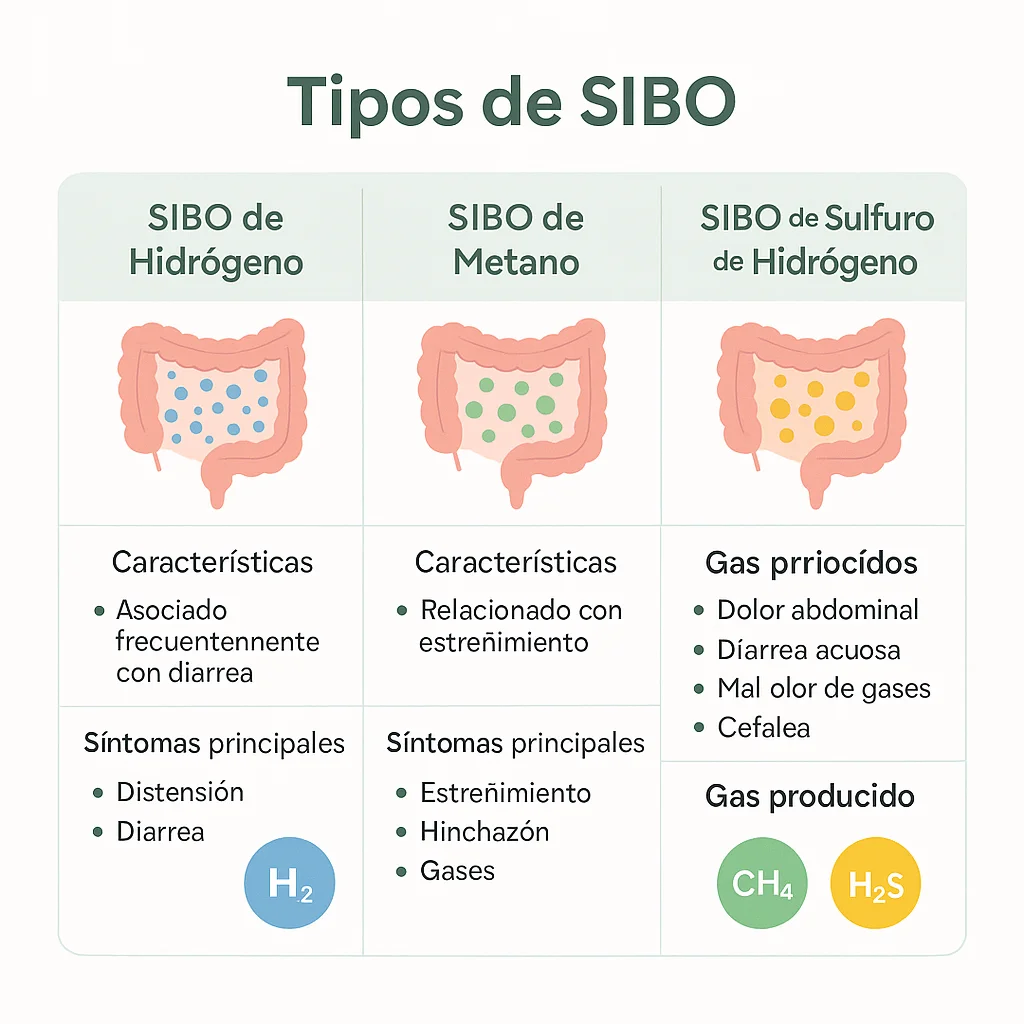
- Hydrogen (H2): produced by bacteria as they ferment carbohydrates. It is the gas of “hydrogen SIBO.”
- Methane (CH4): produced by methanogenic archaea (above all Methanobrevibacter smithii). That pattern is called IMO (intestinal methanogen overgrowth).
Hydrogen sulfide (H2S) is the third player. It differs from the other two in something important: it does not come mainly from fermenting carbohydrates, but from breaking down sulfur-containing compounds, such as dietary sulfates and sulfur-containing amino acids. It is produced mainly by sulfate-reducing bacteria (of the sulfate-reducer group, such as certain species of the phylum Thermodesulfobacteriota) and other H2S-producing bacteria like Proteus mirabilis and species of the genus Desulfobulbus [1].
Some people call this picture ISO, for Intestinal Sulfide Overproduction [2], just as the methane pattern is called IMO. It is not yet a name that appears in every clinical guideline; it coexists with the more informal label “H2S SIBO.”
If you want the complete picture of the gases and why management changes depending on each one, it is in the guide on methane vs. hydrogen SIBO. And to understand how the test is done and prepared for, the guide on the breath test for SIBO has all the steps.
Symptoms that are often associated
H2S has a symptom profile that, in recent research, tends to run in the opposite direction to methane’s:
- Diarrhea as the most commonly reported symptom. In a 2025 study that compared breath with samples from the small intestine, H2S producers were associated with softer stools, while methane correlated with greater severity of constipation [1]. The clinical sources that describe the H2S pattern insist that diarrhea is its most characteristic symptom [2].
- Bloating, abdominal pain and gas.
- Intense odors (“rotten egg”), which is the characteristic smell of hydrogen sulfide. It is something many people notice, but the smell alone does not diagnose anything: there are many causes of foul-smelling gas.
- Some sources also mention fatigue or brain fog, although that association is more poorly characterized.
It is worth reading this list as associations, not as an unmistakable fingerprint. Diarrhea, bloating and gas are symptoms shared by a great many digestive conditions; on their own, they do not allow you to conclude that H2S is present.
The “flat-line curve” pattern in the hydrogen test
Here is the reason so many people land on this topic. The classic breath test measures hydrogen and methane, but does not measure hydrogen sulfide. That creates a blind spot.
The hypothesis some clinicians work with is the following: H2S-producing bacteria consume hydrogen to make sulfide. If that pathway is very active, the hydrogen generated by other bacteria could “disappear” into H2S production before being reflected in the breath. The result would be a flat or very low hydrogen curve, with no methane, even though the person has marked symptoms. That pattern is informally called “flat-line” or flat curve, and it has been proposed as a clue to possible excess H2S.
But several things have to be said clearly:
- A flat curve does not prove H2S. It can also mean a genuinely negative test, an incomplete preparation, altered transit or, simply, that there was no fermentative overgrowth.
- It is an inference, not a measurement. As long as the test does not measure H2S, “deducing” H2S from a flat curve is a reasoned hypothesis, not a confirmed diagnosis.
- The direct way to assess the gas is a test that actually measures it, not reading between the lines of a hydrogen curve.
That is why, if your report shows flat hydrogen and methane and you have clear symptoms, the sensible thing is to discuss it with a professional, not to conclude on your own that you have H2S.
The tests that do measure it (and their limits)
In recent years, breath tests appeared that add H2S to the two classic gases. The best known is trio-smart, described as the main commercially available test that measures all three gases—hydrogen, methane and hydrogen sulfide—in a single sample [4]. Its arrival responded precisely to the blind spot of two-gas tests.
About the thresholds, you have to be careful:
- The 2017 North American Consensus, which is the reference document for hydrogen and methane thresholds, does not yet define an official positivity value for H2S [3]. It is a gas that is still being characterized.
- The thresholds in circulation (for example, considering H2S elevated above a certain level in parts per million) come mainly from the test manufacturer and its research group, not from a consensus of guidelines. They are commercial or preliminary proposals, and the literature itself notes that the understanding of these cutoffs “is evolving” [4]. Recent research does suggest, qualitatively, that higher H2S levels better distinguish patients with diarrhea from those with constipation [1][4], but that is a direction, not a number carved in stone.
The honest reading: the three-gas test closes a real gap, but the framework for interpreting H2S is younger and less validated than that of hydrogen and methane. An H2S result is better interpreted alongside the clinical picture than as an isolated number.
Notions of a low-sulfur diet
Because H2S comes from breaking down sulfur-containing compounds, an intuitive idea is to temporarily reduce dietary sulfur to “give those bacteria less raw material.” This is what is called a low-sulfur diet. In practice it usually means limiting, for a time, sulfur-rich foods such as:
- Garlic and onion.
- Cruciferous vegetables (broccoli, cauliflower, cabbage, Brussels sprouts).
- Eggs.
- Excessive red meat.
On the evidence, it is worth being frank: clinical sources describe that many people notice short-term symptom relief (less bloating, gas and discomfort) when they reduce sulfur for a few weeks, but they also acknowledge that the specific research remains limited and that it is more of a temporary relief strategy than a cure validated in large trials. The low-sulfur diet is usually framed as a symptomatic bridge while the underlying cause is addressed, not as a treatment in itself.
Two important nuances:
- It is a restrictive diet, one that eliminates very nutritious foods (cruciferous vegetables, eggs, garlic, onion). Keeping it up for a long time without supervision can impoverish your diet.
- It is not the same as the low-FODMAP diet. If you want to understand that other approach, there is the guide on the low-FODMAP diet, which targets carbohydrate fermentation, not sulfur.
For all these reasons, a low-sulfur diet is better decided on and bounded with a professional—ideally a dietitian—who can make sure it does not turn into a chronic restrictive pattern.
How it fits into the whole
To keep perspective, here is how the three gases line up:
| Gas | Who produces it | Main origin | Most associated symptom | State of the evidence |
|---|---|---|---|---|
| Hydrogen (H2) | Fermenting bacteria | Carbohydrate fermentation | Diarrhea | Established (consensus threshold) |
| Methane (CH4 / IMO) | Methanogenic archaea | Hydrogen consumption | Constipation | Established (consensus threshold) |
| Hydrogen sulfide (H2S / ISO) | Sulfate-reducing bacteria and other H2S producers | Sulfur breakdown | Diarrhea | Emerging and limited (no consensus threshold) |
The right-hand column is the one most worth remembering: H2S is a field where the science is advancing, but it does not yet have the solidity of the other two gases. Treating it with that caution is not weakness, it is precision.
Closing
Hydrogen sulfide is a real third gas, with a profile of its own—more tied to diarrhea than to constipation—and with tests that can already measure it. But its clinical story is only just being written: there is still no consensus threshold, “flat” curves are a clue and not proof, and the low-sulfur diet relieves some people in the short term without being a validated solution. If an atypical curve or persistent diarrhea brought you here, the next step is not to self-diagnose H2S: it is to bring the complete report—and these questions—to a professional who can interpret it with your history.
Disclaimer: this guide is educational and summarizes public sources; it does not diagnose, treat or replace medical consultation. If you have a breath test report, take it to a health professional to interpret it with your clinical history.
References
- Villanueva-Millan MJ, Leite G, Morales W, et al. Hydrogen Sulfide and Methane on Breath Test Correlate with Human Small Intestinal Hydrogen Sulfide Producers and Methanogens. Dig Dis Sci. 2025. PMC
- trio-smart. Intestinal Sulfide Overproduction (ISO). Gemelli Biotech. trio-smart
- Rezaie A, Buresi M, Lembo A, et al. Hydrogen and Methane-Based Breath Testing in Gastrointestinal Disorders: The North American Consensus. Am J Gastroenterol. 2017;112(5):775-784. PMC
- trio-smart. Understanding Your SIBO Breath Test Results. Gemelli Biotech. trio-smart
Important editorial note
This information is for educational purposes only and does not replace individualized professional advice. Always discuss decisions about your health with a qualified professional.
Sources and references
These references guide how this piece is written and updated. They do not replace individual clinical assessment.
Reference1
ACG Clinical Guideline: Small Intestinal Bacterial Overgrowth (2020)Guía clínica del American College of Gastroenterology para diagnóstico y tratamiento.
Reference2
AGA Clinical Practice Update on Small Intestinal Bacterial Overgrowth (2020)Actualización de buenas prácticas con énfasis en límites diagnósticos y manejo clínico.
Reference3
Hydrogen and Methane-Based Breath Testing in Gastrointestinal Disorders: The North American Consensus (2017)Documento de consenso para preparación, interpretación y umbrales del test de aliento.
Reference4
European guideline on hydrogen and methane breath tests (2022)Consenso europeo sobre indicaciones, preparación y limitaciones del test.
Beiker Guillen
Founder of Sibo Wise
I'm not a health professional — I'm a software developer. I started Sibo Wise when my sister was diagnosed with SIBO and I saw how hard it was to find clear, trustworthy information. My role here is research and organization: I gather what serious medical sources say —clinical guidelines from the ACG and AGA, Monash University materials, and PubMed-indexed studies— and cross-check every claim against its original source before publishing.
This content does not replace professional medical advice. If you have any concerns about your health, consult a qualified gastroenterologist or dietitian.